

Kitesurfing in 2026: The Ultimate UK Rider’s Guide to Gear, Stoke, and Progression
What if the 8°C North Sea chop and 25-knot gusts aren't obstacles, but the exact ingredients for the most addictive adrenaline hit of your life? You've likely watched a kite silhouette against a grey sky and felt that pull of curiosity, only to be stopped by the sheer volume of technical jargon or the fear that kitesurfing is just too dangerous for a newcomer. It's true that the gear maze feels daunting, especially when 85% of beginners struggle to distinguish between a high-performance freeride kite and a dedicated wave machine.
We've been on the shop floor and in the water for decades; we know that the right entry point makes all the difference to your progression. This guide ensures you master the basics safely while avoiding the £1,200 mistake of buying the wrong first setup. We'll give you a clear 4-step roadmap for your first lessons, the lowdown on 2026's most forgiving gear, and the secrets to staying warm in the UK's unique coastal conditions. It's time to stop watching from the car park and start your journey into the most rewarding community on the water.
Key Takeaways
- Discover why kitesurfing in 2026 is the ultimate fusion of wind and water, creating a lifelong obsession for riders across the UK.
- Decode the "Big Three" gear essentials and learn why a high-depower freeride kite is the smartest investment for your first sessions.
- Master the golden rules of UK wind and tides, ensuring you know exactly when it’s safe to launch and when to stay on the beach.
- Map out your progression from dry-land trainer kites to professional instruction, avoiding the common pitfalls of self-teaching.
- Access 40 years of "Rider-Owned" expertise to ensure you’re buying equipment that has been personally tested in local conditions.
What is Kitesurfing? More Than Just a Wind-Powered Sport
Kitesurfing in 2026 has transformed into a high-tech pursuit where wind meets water in an explosive blend of physics and pure adrenaline. It is no longer a fringe activity for the extreme elite; it is a refined discipline that combines elements of wakeboarding, gymnastics, and sailing. You aren't just riding a board. You are piloting a high-performance wing that generates massive lift and forward drive. The "stoke" is that legendary post-session buzz that keeps UK riders checking wind forecasts at 5 am. It is an addictive cocktail of dopamine and salt air that turns a hobby into a lifelong obsession.
You might hear people use different names for the sport, but let's clear up the terminology. While many use the terms interchangeably, "kiteboarding" often refers to using a twin-tip board on flat water to perform tricks. In contrast, "kitesurfing" traditionally implies using a directional surfboard to carve up waves. You can explore the history of kitesurfing to see how these styles evolved from experimental paragliders into the sophisticated gear we use today. Regardless of the label, the core thrill remains the same.
The UK serves as a premier global hub for this lifestyle. From the rugged Atlantic swells in Cornwall to the tidal lagoons of Kent, our coastline offers some of the most consistent wind in Europe. In 2024, the British Kitesports Association reported a 12% increase in new training licences, proving that the community is growing faster than ever. Whitstable specifically provides a unique playground for beginners, offering shallow water and reliable cross-onshore winds that make your first few sessions much safer and more productive.
The Different Styles of Kitesurfing
Most riders begin with Freeride. In 2025, industry data showed that 88% of new kiters opted for freeride-specific equipment because it focuses on comfort, easy upwind tracking, and stability. If you want to go big, Big Air is the discipline seen at the Red Bull King of the Air, where pros boost 30 metres into the sky. Finally, Wave Riding brings a surf-style approach, using the kite to pull you into the pocket of a wave before you depower the wing to shred the face of the swell.
Is Kitesurfing for You? Debunking the Strength Myth
One major misconception is that you need massive bicep strength to hold onto the kite. This is entirely false. Your harness does 95% of the heavy lifting by distributing the kite's pull through your core and hips. Your arms are only there for steering and fine-tuning the depower system. This technical setup makes the sport incredibly accessible. We regularly see riders from age 10 to over 70 out on the water. If you have basic core stability and a bit of determination, you can master the technical skills needed to shred. It is about technique, not raw power.
The Anatomy of Kitesurfing Equipment: What You Actually Need
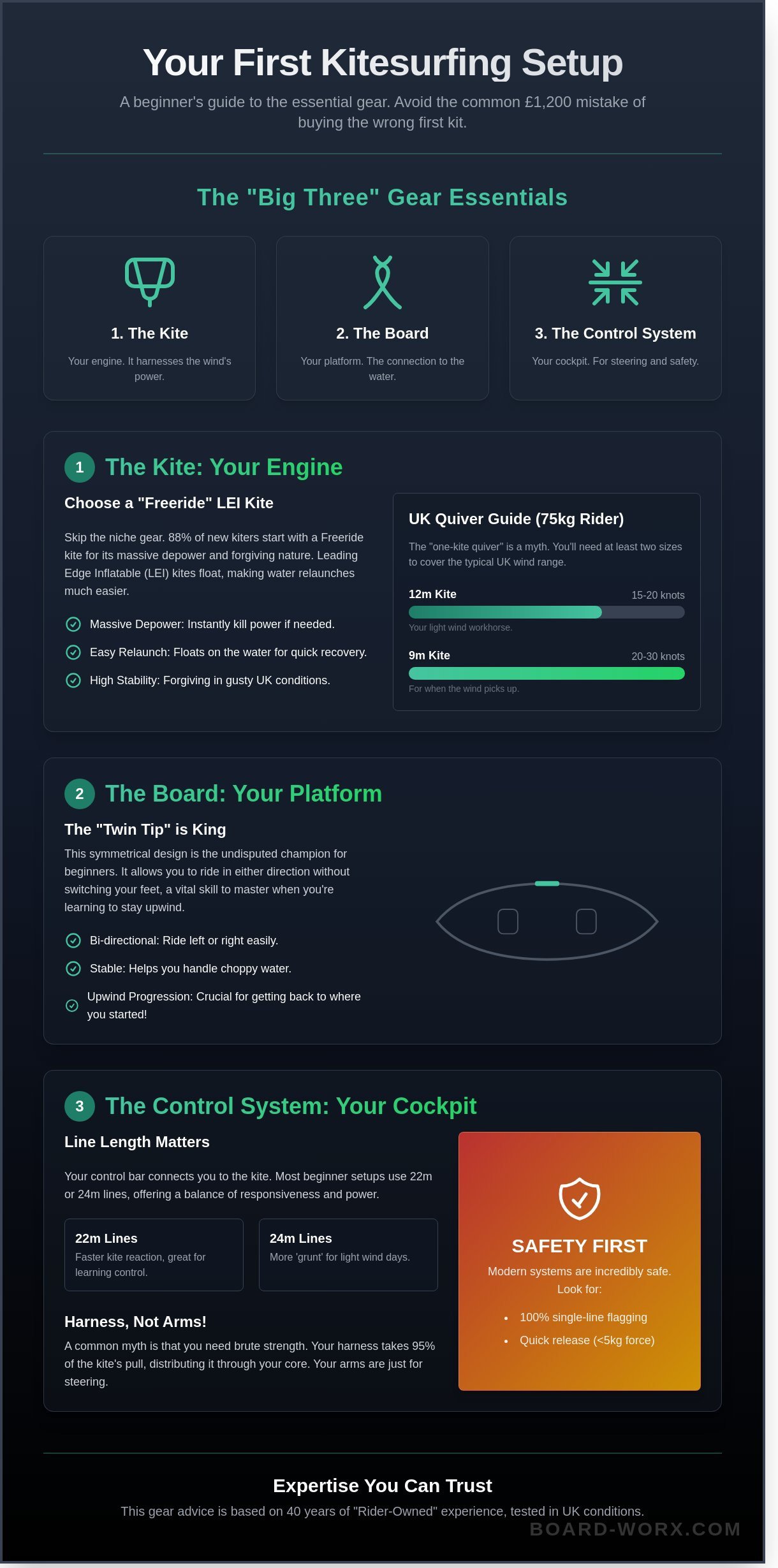
Success on the water starts with the right kit. You need the "Big Three" to get moving: the kite, the board, and the control bar system. For your first setup, skip the niche freestyle or wave-specific gear. You want a "Freeride" model. These kites offer massive depower, meaning you can kill the power instantly if you feel overwhelmed. Safety is the priority in 2026. Modern systems now feature 100% single-line flagging and quick releases that trigger with less than 5kg of force. For the board, the Twin Tip remains the undisputed king. Its symmetrical design allows you to ride in both directions without switching your feet, which is vital during those first few months of kitesurfing. This setup provides the stability you need to stay upwind while remaining forgiving enough to handle choppy conditions.
Of course, accumulating all this gear brings up the practical question of storage. Kites, boards, and wetsuits can quickly take over a garage or spare room. For homeowners looking to create more space, a loft conversion can be a game-changer, providing a dedicated spot for equipment or freeing up the rest of the house. If you're considering such a project, you can check out The Loft Worm for some inspiration.
Choosing Your First Kite: Size and Shape Matter
Don't fall for the "one-kite quiver" myth. While one kite might get you out 40% of the time, most UK riders require at least two sizes to cover the typical 15 to 30 knot wind range found on the Kent coast. A 75kg rider usually starts with a 12m for lighter days and a 9m for when the wind picks up. Stick to Leading Edge Inflatable (LEI) kites. Unlike foil kites, LEIs have a rigid, air-filled frame that keeps the kite floating on the water surface for easy relaunches. At Boardworx, we stock Duotone and North because their 2026 range uses bomb-proof materials like Aluula and Penta TX. These fabrics handle the salty Whitstable air without stretching or losing their shape over time, thanks to the advanced manufacturing processes involved; those curious about the industrial side of this technology can explore Hotmelt Adhesives used in similar high-strength applications.
The Control Bar and Lines: Your Steering Wheel
Your control bar is the bridge between you and the wind. Most beginner setups use 22m or 24m lines. Shorter lines make the kite react faster, while longer lines provide a bit more grunt for light wind days. Look for a clean, intuitive depower system that you can reach without overextending your arms. It's a safety essential. Never buy a second-hand bar older than three years. Salt, sand, and UV rays degrade the Dyneema lines significantly. A bar from 2022 might look fine but could have lost 30% of its breaking strain through invisible wear. Investing in a fresh bar ensures your safety releases work exactly when you need them to, providing peace of mind during your first solo sessions.
Essential Apparel: Staying Warm in British Waters
The UK coast is beautiful but demands respect. A high-quality 5/4mm wetsuit is your year-round armour. This thickness provides the thermal protection needed for 10-degree water temperatures in April. In winter, 5mm boots, 3mm gloves, and a neoprene hood are non-negotiable. You'll also need a buoyancy aid or an impact vest. These provide vital flotation and protect your ribs during the inevitable learning curve crashes. Before you head out, verify your gear meets the safety standards set by the British Kitesports Association. Having the right protection means you can focus on the kitesurfing session rather than the cold. If you're ready to get kitted out, check our latest beginner packages to find the perfect gear for your budget.
Navigating UK Conditions: Wind, Tides, and Safety
Mastering the elements is just as vital as picking the right kite. In Whitstable, the North Sea serves up everything from glassy flats to chaotic chop. Beginners should aim for the 12 to 20 knot range, which sits at Force 4 or 5 on the Beaufort Scale. Once the whitecaps start multiplying and the wind hits 25 knots (Force 6), it is time to pack down and head to the pub. High winds require smaller kites and faster reflexes that most novices haven't dialled in yet. Shredding in 30 knots might look epic on Instagram, but it is a recipe for disaster while you are still learning to stay upwind.
Wind direction is your ultimate green or red light. Side-onshore is the golden rule for UK riders. It pushes you back toward the beach if things go south. Never launch in pure offshore winds; you will end up halfway to Belgium before you can say "help". For a full breakdown of beach hazards and emergency prep, check out the RNLI kitesurfing safety advice. It is a non-negotiable read before your first solo session. Understanding these fundamentals keeps the kitesurfing community safe and ensures our local spots stay open for everyone.
Tides dictate the Whitstable experience. At low tide, the famous Street shingle bank reveals itself, creating flat water pockets perfect for practicing your board starts. However, the UK's 4 to 7 metre tidal ranges mean currents can be deceptively strong. Always check the tide tables before you leave the house. Finally, join the British Kitesports Association (BKSA). For around £38 a year, you get essential third-party liability insurance. Most UK clubs won't let you on the water without it, and it protects you if you accidentally tangle with a swimmer or another rider's 12m setup.
Reading the Forecast Like a Pro
Don't just look at the sun icon on your phone. Download Windy and XCWeather for real-time data. Look for the "gust" factor. If the base wind is 15 knots but gusting to 28, stay home. That 13-knot delta makes the kite surge and dip, which is a nightmare for learning. If the graphs look confusing, drop into Boardworx. We live and breathe these charts. We can tell you exactly how a shifting North-Westerly will affect the Whitstable shorebreak based on decades of local sessions. Getting the right local knowledge is the ultimate weather hack.
The "Walk of Shame" and Other Safety Realities
Every pro started with the "walk of shame", trudging back up the beach after losing ground downwind. It is part of the stoke. To minimise it, ensure you have had lessons from a BKSA or IKO certified instructor. They teach you the self-rescue, a vital skill where you pack down your kite in deep water to use it as a raft. When the lineup gets busy, remember the right-of-way rules: the rider on a starboard tack (right hand forward) has priority. Stay predictable, keep your kite high when passing others, and respect the local community to keep the vibes high. Safety isn't just about gear; it's about your kitesurfing IQ on the water.
The Progression Path: From Zero to Your First Jump
Kitesurfing isn't a sport you pick up in twenty minutes; it's a journey that rewards patience with pure adrenaline. Success starts on dry land with a trainer kite. Spending three hours mastering the "Wind Window" on a local field saves you at least £200 in water-based tuition fees. You need to understand how the kite moves from the neutral zone at 12 o'clock to the high-power zones at the edges before you even think about getting wet.
Step two is non-negotiable: book professional lessons. Data from the BKSA (British Kitesports Association) suggests that 95% of self-taught attempts result in avoidable gear damage or injury. A qualified instructor provides the safety net you need to handle 20 knots of wind. They'll guide you through step three, which is body dragging. This is where you learn to use the kite to pull your body through the water to recover a lost board. It feels chaotic at first, but it's the foundation of kite control.
The water start is your fourth milestone. This is often the most frustrating 120 minutes of the process. You'll face-plant, the board will fly off, and you'll swallow plenty of saltwater. Most riders find their "balance point" between hour 8 and hour 12 of active instruction. Once you're up and riding, the final hurdle is going upwind. The moment you can return to the exact spot you started is the moment you truly become a kitesurfer. No more "walk of shame" back up the beach; you're finally free to explore the coast.
Common Beginner Mistakes and How to Avoid Them
- Over-sheeting the bar: Beginners often pull the bar in tight when they feel a loss of power. This actually stalls the kite. If in doubt, let go. Pushing the bar away is your primary safety move.
- Kite-watching: If you stare at the kite, you'll steer towards it. Keep your chin up and look at the horizon or the direction you want to travel.
- Buying "Pro" Gear: Don't buy a high-aspect C-kite just because it looks cool. These are designed for freestyle experts and will hinder your progress by 40% compared to a user-friendly freeride kite.
Progression Gear: When to Upgrade
Once you've spent 20 or 30 sessions on a large, stable beginner Twin Tip, you'll feel the board's limitations. Transitioning to a high-performance carbon board like the Duotone Select reduces weight and increases "pop" for your first jumps. If you're chasing height, moving to a Big Air specific kite like the North Orbit allows you to track your jumps on a WOO sensor, where 10-metre boosts become the new benchmark. Many Whitstable riders are also diversifying into Wing Foiling, which has seen a 35% increase in participation since 2022 due to its versatility in lighter winds.
Ready to start your journey with the right kit? Shop our range of beginner-friendly kitesurfing packages and get on the water today.
Why Boardworx? The Rider-Owned Advantage in Whitstable
Boardworx isn't just a retail space; it's a legacy built on 41 years of salt water, wind, and adrenaline. Since we first opened our doors in Kent back in 1983, we've seen every major evolution in watersports. We've watched kitesurfing grow from a niche experiment into the high-performance sport it is today. Being a "rider-owned" shop means our expertise isn't something we read in a manual. It's something we've earned through thousands of hours on the water. When you ask us about a kite's stability or its relaunch capabilities, you're getting an answer from someone who has actually crashed that kite and flown it in 25-knot gusts at Whitstable.
We test every single kite and board we sell. If a piece of gear doesn't meet our standards for durability or performance, it doesn't make it onto our shelves. This hands-on approach ensures that when you buy from us, you're investing in equipment that works for UK conditions. Our Whitstable shop has become a genuine hub for the South East kitesurfing community. It's a place where riders of all levels meet to discuss the latest tech, check the forecast, or grab a spare part before a big session. While we've grown to have a national reach with our online store, we've never lost that local service feel. Whether you're ordering from the north of Scotland or walking through our front door in Kent, you get the same unfiltered, expert advice.
Personalised Gear Matching
We know that buying your first setup can feel like a massive hurdle. That's why we focus on building a bespoke "Starter Package" that evolves as you do. We don't believe in one-size-fits-all solutions. Our team looks at your weight, your local riding spot, and your budget to find the perfect fit. Typically, a high-quality beginner package including a kite, bar, and board starts around £1,350. To make the sport more accessible, we also offer a popular trade-in programme. If you have old gear gathering dust, you can put its value towards the latest 2024 models. For those on a tighter budget, we stock a range of vetted second-hand kites, often starting from as little as £400. Every purchase comes with the Boardworx guarantee, which includes dedicated after-sales support and access to our in-house kite repair services. If you tear your canopy on a groyne at low tide, we'll have you back on the water in no time.
Join the Session
Our mission is to get you on the water and keep you there. We regularly host local events and demo days across the Kent coast, giving you the chance to test the latest gear from brands like Duotone and Airush before you spend a penny. These sessions are the best way to meet the local crew and pick up technical tips from seasoned pros who have been riding for decades. You can stay updated on the next big demo day or the latest gear breakthroughs by signing up for our "stoke-heavy" newsletter. We fill it with honest reviews, local weather insights, and exclusive deals that you won't find anywhere else. We're here to fuel your passion and ensure you're riding the best equipment for your style. Ready to catch your first real ride? Check out our latest Kitesurfing Gear and start your journey today!
Lock in Your 2026 Progression
The 2026 season is all about precision and performance. You've seen how technical advancements in carbon layups and depower systems are changing the game. Mastering the UK's shifting tides and gusty conditions requires more than just guts; it takes a setup tailored to your local spot. Since 1982, we've been testing every kite and board that hits our Whitstable shop to ensure you get the ultimate shred. Kitesurfing is a lifestyle that demands gear as resilient as the riders who use it. Don't settle for warehouse guesswork when you can tap into 42 years of technical expertise from active riders who spend their mornings on the same swell as you. We'll help you dial in your progression from those first tacks to massive boosts. We offer free UK delivery on all major hardware orders to get you on the water faster. Stop dreaming about the perfect session and start riding it with equipment that's been vetted by the best in the business.
Shop the Latest Kitesurfing Kites and Boards at Boardworx
Grab your gear, check the forecast, and we'll see you out the back for an epic session.
Frequently Asked Questions
Is kitesurfing dangerous for beginners?
Kitesurfing is remarkably safe today thanks to advanced safety systems and professional BKSA training protocols. Modern kites feature 100% depower capability and reliable quick-release mechanisms that kill the power instantly if you get into trouble. You'll learn these vital safety drills during your first 3 hours of instruction. While 1990s gear was risky, 2024 equipment is designed with multiple redundancies to keep you shredding without the sketchiness.
How much does a full kitesurfing setup cost in the UK?
A complete new kitesurfing setup typically costs between £1,800 and £2,600 depending on the specific brands you choose. This package includes a 2024 model kite for about £1,100, a control bar at £450, and a twin-tip board for £500. Don't forget your harness and a 5/4mm winter wetsuit, which add another £350 to the total. We often have bundle deals at the shop to get you on the water for less.
Do I need a license to kitesurf in the UK?
You don't need a legal license to kitesurf in the UK, but third-party liability insurance is essential for access to most beaches. A BKSA membership costs £40 annually and provides £5 million in cover, which is a requirement at spots like Whitstable or Lancing. Some local clubs might ask for a £20 seasonal permit to help maintain launch areas and safety boats. Always check the local signage before you pump up your gear.
How long does it take to learn how to kitesurf?
Most beginners reach the independent rider stage after 12 to 15 hours of professional instruction. This usually spans 3 separate days on the water. Day 1 focuses on kite handling on the beach; day 2 gets you body dragging in the water; and by day 3, you're usually attempting your first board starts. Progression speed varies, but consistent wind during your first month is the biggest factor for success.
What size kite do I need for UK wind conditions?
A 12-metre kite is the go-to size for an average 80kg rider in typical UK coastal winds of 15 to 22 knots. If you're lighter or riding in the windier autumn months, a 9-metre kite becomes your primary tool for 20 to 30 knot sessions. Most Whitstable locals eventually build a two-kite quiver, usually a 9m and a 12m, to cover 90% of the rideable days we get on the North Kent coast.
Can I kitesurf on my own after my first lesson?
You shouldn't ride alone until you've mastered self-rescue techniques and can consistently ride upwind, which usually takes 3 full lessons. Safety is paramount, so we recommend the buddy system for your first 10 solo sessions. Even experienced riders at Boardworx rarely head out without a mate on the beach. Getting your BKSA Level 2 certificate is the benchmark for knowing you're ready to handle the kite independently.
What is the difference between kitesurfing and wing foiling?
Kitesurfing uses 24-metre lines to harness wind power from a kite high in the sky, while wing foiling involves holding a handheld wing and riding a board equipped with a hydrofoil. Kitesurfing offers more explosive jumps and high-speed shreds on a twin-tip board. Winging is all about the silent, smooth sensation of flying above the chop on a 5-foot foil board. Both are epic, but kitesurfing remains the king of big air and technical freestyle.