

Learning Wing Foiling in 2026: The Ultimate UK Beginner’s Guide to Flight
What if you could trade the drag of a traditional surfboard for the silent, frictionless flight of a hydrofoil by your third session? You’ve likely watched riders at spots like Weymouth or Poole Harbour gliding effortlessly while you’re stuck decoding jargon like high-aspect wings and fuselage lengths. Learning wing foiling shouldn't feel like you need an engineering degree just to get wet, especially when you're worried about dropping £2,800 on a setup you might outgrow by August. We know the feeling of standing on the shingle at Hayling Island, wondering if that 15-knot gust is a dream or a disaster.
Our team has stripped back the noise to give you a definitive roadmap for 2026, ensuring you choose a progression-friendly kit that survives the North Sea chop. We’ll break down the exact gear specs that offer the most stability for beginners without sacrificing the speed you'll crave later. From mastering your first taxi to understanding the specific safety protocols for UK coastal winds, this guide covers everything you need to hit the water with total confidence. It’s time to stop watching from the beach and start your flight.
Key Takeaways
- Unlock the sensation of frictionless flight by mastering the ultimate hybrid of windsurfing and kitesurfing tailored for UK waters.
- Get to grips with the essential anatomy of your setup, ensuring your wing, board, and hydrofoil are perfectly tuned for maximum lift.
- Follow our proven three-stage progression strategy to accelerate learning wing foiling, moving from land-based drills to your first sustained glide.
- Identify the safest UK weather windows by learning to spot 'clean' side-onshore winds that guarantee a productive and safe session.
- Avoid costly mistakes with our 'Weight + 30' volume rule, helping you choose a progression package that balances stability with high-performance potential.
What is Wing Foiling? Understanding the 2026 Watersports Revolution
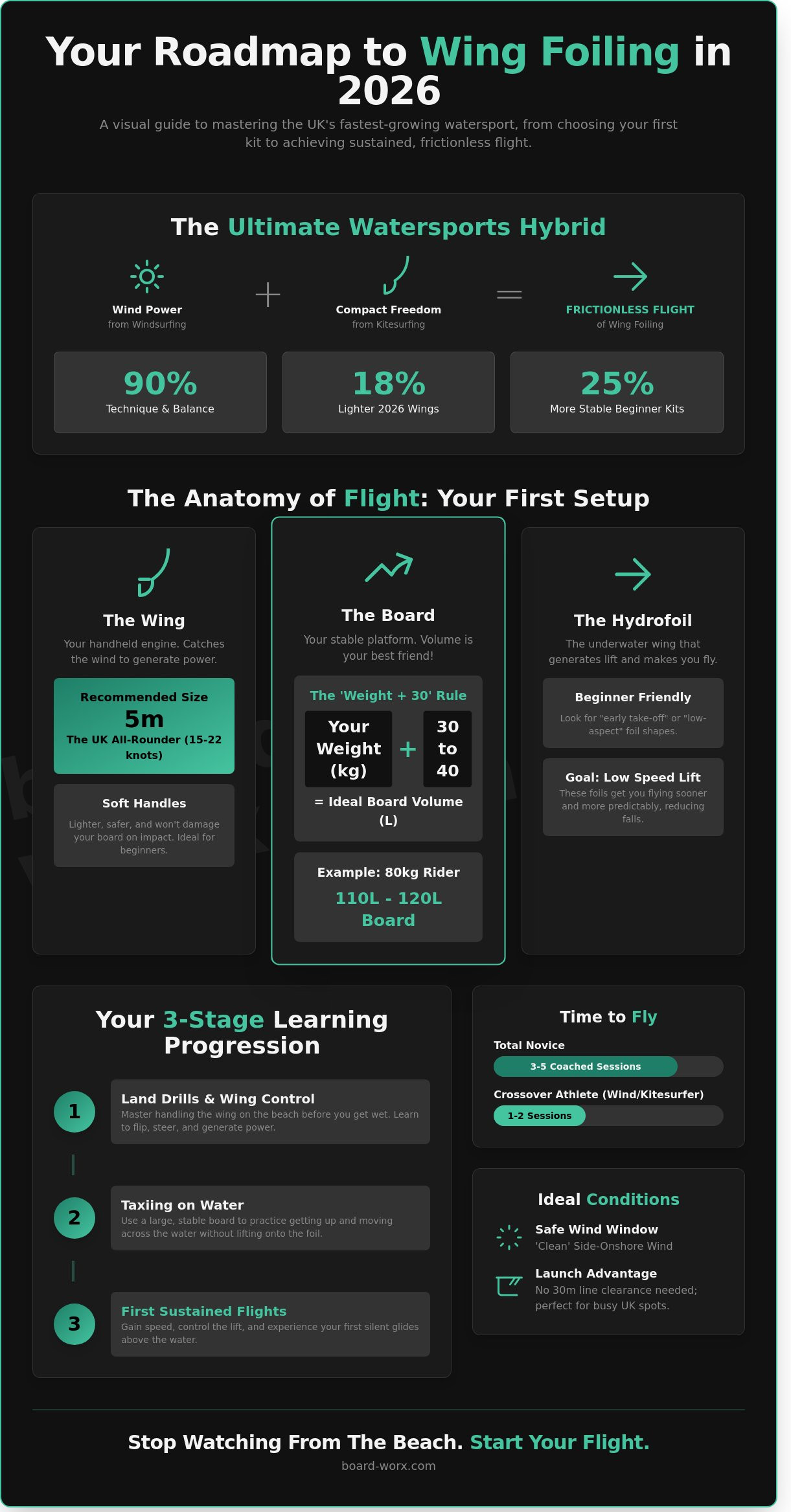
Wing foiling is the definitive hybrid of the modern era. It fuses the raw wind-power of windsurfing with the compact freedom of kitesurfing, then adds the silent, "frictionless" glide of a hydrofoil. By 2026, the sport has evolved from a niche experiment into the most accessible way to experience flight on the water. You hold a handheld inflatable wing to catch the breeze while standing on a board equipped with a high-performance foil. Once you hit a specific speed, the foil generates lift, hoisting you 60cm above the chop into a world of pure silence. Learning wing foiling isn't about brute force. It's a game of 10% strength and 90% technique. If you can hold a bag of groceries, you have enough muscle to wing.
The 2026 gear landscape has changed the game for newcomers. Modern wings utilize Aluula and ultra-lightweight ripstop materials that have reduced overall weight by 18% compared to early 2020s designs. This means the wing stays aloft in light 8-knot breezes, making your first sessions far less fatiguing. Foil profiles are now more stable too; they offer "early take-off" shapes that get you flying at lower speeds, reducing the impact of those inevitable early tumbles. It's about efficiency, not ego.
The 'Stoke' Factor: Why This Sport is Taking Over the UK
The UK coastline is notoriously crowded, but winging thrives where other sports struggle. Unlike kitesurfing, you don't need 30 metres of line clearance to launch, making it perfect for busy spots like Poole Harbour or the cramped pebble beaches of the South Coast. You have total freedom. There's no heavy mast or complex rigging to lug across the sand. You pump up, walk in, and go. The community in 2026 is massive; you'll find foiling hubs at almost every local club, offering a lifestyle built around tide charts and high-performance sessions rather than just sitting on the beach.
Assessing Your Starting Point: Do You Need Prior Experience?
You don't need a CV full of watersports to succeed, but a background in wing surfing or SUP certainly shortens the curve. A total novice usually spends their first two sessions mastering wing control on a high-volume board before attempting to fly. If you're a seasoned wind-rider, you might be on the foil within 90 minutes. The biggest hurdle is psychological. Moving from "riding on water" to "flying above it" feels alien at first. You have to learn to trust the lift, but once that foil engages, the sensation is addictive.
- Total Novices: Expect 3 to 5 coached sessions to achieve sustained flight.
- Crossover Athletes: Windsurfers and kiters often nail the transition in 1 to 2 sessions.
- The Gear Advantage: 2026 beginner kits are 25% more stable than 2022 equivalents.
- Focus: Prioritise balance over power to speed up your learning wing foiling journey.
The Anatomy of Flight: Understanding Your Wing Foil Gear
Your gear choice is the single most important variable in your early success. It's the difference between a frustrating afternoon of swimming and that first, silent glide above the chop. Learning wing foiling requires three distinct pieces of tech to work in perfect sync: the wing, the board, and the hydrofoil. These components convert wind energy into vertical lift, but the wrong setup will leave you stalled. In the UK, where conditions shift from 15-knot breezes to 25-knot gusts in minutes, your kit needs to be versatile. Don't forget your rubber; a high-quality 5/4mm wetsuit is essential for staying warm enough to actually focus on your progression.
The Wing: Your Portable Power Plant
Think of the wing as a handheld sail. It features an inflatable leading edge and a central strut that provide the rigid skeleton needed to catch the wind. Most UK riders find a 5m wing is the ultimate all-rounder for our typical 15 to 22-knot days. You'll choose between soft handles or a rigid boom. Handles are lighter and safer for beginners, as they won't ding your board or your head during a wipeout. A 5m wing provides enough grunt to get you on foil without being too cumbersome to flip over in the water.
The Foil Board: Stability vs. Performance
Volume is your best friend. For your first sessions, look for a board with a volume in litres that is at least 30 to 40 units above your body weight in kilograms. An 80kg rider should start on a 110L to 120L board to ensure a stable platform while standing. Hard boards offer the best performance and direct feel, but modern inflatable wing boards are now 90% as good and fit easily into a small car boot. Look for deep deck pads for grip and strap inserts so you can add footstraps once you're ready to jump. If you want to get on the water faster, explore the latest wing foil packages designed for rapid progression.
The Hydrofoil: The Engine Under the Water
The hydrofoil is a complex assembly of a mast, fuselage, front wing, and stabiliser. For beginners, a 75cm or 85cm aluminium mast is the sensible choice. It's durable, cost-effective, and provides enough height to clear the coastal chop. You want a low-aspect front wing, usually between 1800cm² and 2000cm², which provides lift at low speeds. These fat wings are incredibly stable, making it much easier to find your balance when learning wing foiling. You can always upgrade to high-performance carbon components once your carving improves and you start hunting for more speed.
The Learning Progression: From First Flight to Sustained Gliding
Learning wing foiling is a game of three distinct stages. You will spend your first few hours looking like a confused windmill, but that is all part of the stoke. To fast-track your progress, you must embrace a crash and learn mentality. Every dunking is just your brain recording what not to do. Muscle memory builds fastest when you are pushing the limits of your balance, so do not play it too safe. Expect to fall 20 times in your first hour. It is the only way to find the limit.
Phase One: Mastering the Wing on a SUP
Your first session should always be on a large, stable paddle board without a foil. Use an inflatable SUP with at least 150 litres of volume to provide a solid platform. This stage is about understanding how the wing breathes. You need to learn how to steer, tack, and gybe using only wind power before adding the complexity of a foil. Practice the neutral position by holding the leading edge handle. This kills the power instantly, which is vital for handling 15-knot gusts safely. Master this on a 10 foot 6 inch board and you will save yourself days of frustration later.
Phase Two: The First Flight and Finding Balance
Graduating to a foil board requires board speed. This is the taxiing phase. You need enough forward momentum to create the hydrodynamic lift required to rise. Use the pop-up technique: move from your knees to your feet in one fluid motion once the board is planeing. Your foot placement is critical. Keep your feet on the centre line, with the back foot directly over the mast and the front foot roughly 45cm forward. Managing pitch and roll is a game of millimetres. If the nose kicks up too high, you will stall. Shift your weight forward to level the flight.
Phase Three: Sustained Foiling and Basic Turns
Once you are airborne, the goal is sustained flight. Avoid breaching, which happens when the foil pierces the water surface and loses lift. Maintain a 60/40 weight distribution with the majority of your pressure on the front leg. When learning wing foiling turns, the first gybe is your biggest hurdle. You must keep the power in the wing throughout the arc to maintain speed. Modern 2026 high-aspect foils allow you to glide through five-second wind lulls if you keep the board level. Follow these technical steps to transition from a beginner to a confident rider:
- Look at the horizon: Your board follows your eyes. Never look at your feet.
- Control the height: Use your front knee as a shock absorber to manage ride height.
- Wing positioning: Keep the wing high and forward to pull you up and out of the water.
- Stay relaxed: Tense muscles lead to over-corrections and spectacular wipeouts.
By the time you reach ten hours of water time, these movements become instinctive. You will stop thinking about the gear and start hunting for the next bump to glide on.
Safety and Conditions: Organising Your Ideal Session
You can't just rock up to the beach and hope for the best. Success in the UK depends on your ability to read the sky and the tide. Learning wing foiling is 50% technical skill and 50% choosing the right window. Aim for side-onshore winds. This direction ensures that even if things go wrong, the breeze eventually pushes you back toward the sand. Avoid offshore winds entirely. They are gusty, dangerous, and will leave you calling the RNLI if you can't stay upwind. Use tools like the Met Office or XCWeather to find "clean" air that isn't turbulent from nearby cliffs or buildings.
Choosing the Right UK Conditions
The sweet spot for beginners is a steady 15 to 20 knots. Anything less and you'll struggle to generate lift; anything more and the wing becomes a handful. Seek out flat water locations like Portland Harbour or the Chichester lagoons. Coastal chop is a progress killer. If you're dealing with a 3.5-metre spring tide, remember that the current can drastically increase your downwind drift. Check the local UK Hydrographic Office charts every single time you head out.
Essential Safety Equipment for Foiling
Don't skimp on protection. A CE-approved 50N buoyancy aid keeps you afloat when you're exhausted. An impact vest is even better, providing a layer of foam to protect your ribs from the board's rails. Helmets are mandatory because a carbon foil is essentially a giant knife under the water. Use a coiled waist leash for your wing. It keeps the leash away from your feet, preventing the tangles that lead to 90% of beginner falls. Ankle leashes are okay for the board, but the waist is where the pros stay snag-free.
Common Beginner Mistakes to Avoid
Ditch the death grip immediately. If your knuckles are white, you're doing it wrong. Use light pressure and let the wind do the heavy lifting. If the board feels unstable, check your foil tracks. Moving the mast just 3cm can be the difference between a balanced flight and a nose-dive. Remember these golden rules:
- Look at the horizon: Staring at your feet is the quickest way to find the water.
- Weight forward: Keep your weight over the centre line to avoid the board "wheelying" out from under you.
- Foil placement: Start with the mast in the middle of the tracks to find a neutral balance point.
If the wind drops to zero, you must perform a self-rescue. Flip the wing over so the struts face the sky, lay it across the front of your board, and paddle like a surfer. It's a standard move that every rider needs to master before heading 500 metres offshore. Practice this in the shallows so it's second nature when the clouds roll in.
Ready to gear up for your first flight? Browse our expert-tested wing foil safety gear to stay protected during every session.
Investing in Progression: Choosing Your First Wing Foil Setup
Ready to pull the trigger on your own gear? Learning wing foiling is an investment in your future stoke, but buying the wrong kit is a fast track to frustration. You need a "Progression Package" that balances immediate stability with enough performance to keep you excited for the next two seasons. For your first board, stick to the "Weight + 30" rule. If you weigh 80kg, you need a board with at least 110L of volume. This extra buoyancy provides the platform you need to master your knee-starts and taxiing without constantly wobbling into the drink.
Sizing Your First Board and Foil
Your foil is the engine under the water. For beginners, a large front wing between 1800cm² and 2000cm² is the gold standard. These wings provide massive amounts of lift at low speeds, meaning you can get on the foil without needing a gale-force wind. Pair this with a shorter mast, ideally 65cm to 75cm. A shorter mast is less intimidating, keeps you closer to the water surface, and makes recoveries from over-foiling much easier. Always opt for a modular foil system. This allows you to swap out just the front wing for a smaller, faster model once your skills improve, saving you from buying a whole new setup in six months.
Selecting the Right Wing and Accessories
In the UK, a 5m wing is the undisputed workhorse for most riders. It covers the typical 15 to 25-knot range found at coastal spots from Hayling Island to Whitstable. Smaller wings are too twitchy for learners, while anything over 6m becomes heavy and cumbersome to handle in the wind. Don't overlook the small stuff; ensure your pump has the correct valve adapter for your specific wing brand to avoid a "no-go" session at the beach. Most importantly, invest in a high-quality technical wetsuit. Keeping your core temperature up is essential for those long sessions where you spend more time in the water than on it.
Why Expert Advice Trumps 'Bargain' Online Buys
It is tempting to grab a "complete kit" from a generic marketplace for £800, but you often end up with outdated foil geometry that makes learning wing foiling twice as hard. These "bargains" usually have poor resale value and lack the spare parts support found with premium brands. A quick consultation on the shop floor can save you hundreds of pounds. We have seen riders buy wings that are too small or foils that are too advanced, only to return a week later to trade them in. Specialist retailers ensure your gear is compatible and tuned for your local conditions. That first moment of silent flight makes every hour of practice and every penny spent on the right gear completely worth it. Get the right kit, hit the water, and join the flight.
Claim Your First Flight on the Water
Learning wing foiling in 2026 is the most direct route to experiencing the sensation of total flight over the UK’s coastal waters. You've now got the blueprint for success, from understanding how high-modulus carbon masts reduce drag to identifying the perfect 18-knot cross-shore breeze for your first session. Progression relies on matching your wing size to the local conditions and ensuring your foil setup provides the stability you need to stay up, typically starting with a front wing between 1800cm2 and 2200cm2. We've been rider-owned and operated since 1982, so our advice comes from decades of genuine salt-water experience. Our crew consists of active foilers who've tested every wing and board in the shop to ensure you get the right kit the first time. We provide expert technical advice and offer UK-wide shipping on all major wing brands to ensure your gear arrives before the next big swell hits. Don't settle for guesswork when you can rely on a specialist hub that lives for the stoke of a perfect session.
Gear up for your first session with our expert-picked Wing Foil Packages
Grab your wing, check the tide times, and prepare for an epic session on the foil.
Frequently Asked Questions
Is wing foiling easier than kitesurfing or windsurfing?
Wing foiling is significantly easier and safer to learn than windsurfing or kitesurfing because the gear is less complex. You don't have 25-metre lines to manage or heavy masts to uphaul. Most students at UK schools find they can handle the wing comfortably within 2 hours. It's a much more intuitive process that lets you focus on the feeling of flight rather than technical rigging.
How much wind do I need to start learning wing foiling?
You need a steady breeze between 15 and 20 knots to start learning wing foiling effectively. While experienced riders can pump onto the foil in 10 knots, beginners need the extra pressure to help the board break surface tension. 18 knots is the magic number for most UK coastal spots. This provides enough grunt to get you moving without the wing becoming difficult to manage.
What size wing should a beginner buy for UK conditions?
A 5-metre wing is the most versatile choice for a beginner in the UK. This size covers a massive wind range from 15 to 25 knots, which represents 70% of typical autumn and spring sessions. If you weigh over 90kg, go for a 6-metre wing to ensure you have the power to lift off. Buying a 5-metre wing ensures you won't outgrow your first piece of kit too quickly.
Do I really need a helmet and impact vest for wing foiling?
You absolutely need a CE-approved helmet and a 50N impact vest for every single session. Foils are essentially sharp 80cm knives made of carbon or aluminium that can cause serious injury during a high-speed wipeout. Data from local clubs shows that 90% of minor injuries are avoided when riders wear proper protection. It's about staying safe so you can get back out for the next session.
Can I learn to wing foil on my own or do I need lessons?
You should take at least one 3-hour RYA-certified lesson to understand safety and basic wing handling. Learning wing foiling without guidance often results in kit damage or drifting into dangerous shipping lanes. An instructor provides a safety boat and instant feedback, which usually speeds up your progression by 4 or 5 sessions. It's a small investment that prevents a lot of frustration on the beach.
How long does it take to get up on the foil for the first time?
Most riders experience their first flight within 3 to 6 sessions on the water. The first 5 hours are typically spent on a large board mastering the wind clock and wing positions. Once you understand how to generate lift, the sensation of foiling usually clicks instantly. By the end of your first month, you'll likely be sustained foiling for 100-metre stretches.
What is the best board volume for a beginner foiler?
The best board volume is your body weight in kilograms plus 30 or 40 litres of extra buoyancy. If you weigh 85kg, you should look for a board between 115 and 125 litres. This extra volume provides a stable platform so you aren't wobbling while trying to uphaul the wing. Stability is your best friend when you're first learning to balance on the water.
Can I use my existing SUP board to learn winging?
You can use a standard SUP for your very first hour to practice wing handling, but you'll need a dedicated foil board to actually fly. A normal 10-foot SUP lacks the foil track and the lateral resistance needed to stay upwind. You'll find yourself drifting downwind at 4mph without any way to get back. Switch to a real foil board as soon as you've mastered the wing basics.