

Kiteboard & Kitesurf Guide 2026: Choosing Your Ultimate High-Performance Setup
That ultra-stiff 2026 carbon board you’ve been eyeing won't make you jump higher; it will actually end your session 30 minutes early if your local spot is full of heavy chop. It’s a common trap to think that more tech always equals more performance, but the 15% increase in torsional stiffness seen in this year's flagship models requires a rider with the precision to match. We know you’re itching to upgrade your kiteboard kitesurf gear for the new season, but the fear of buying a board that’s too technical is real. You want gear that works with you, not against you, when the wind finally hits 25 knots.
We’ve spent over 120 hours on the water testing the latest 2026 prototypes to ensure your next session is pure stoke. This guide will help you master the nuances of carbon layup and rocker lines so you can choose a setup that maximizes your time on the water. We’ll show you how board shape affects your ride and how to select a kite with a depower range that eliminates overlap across a 12 to 40-knot window. By the end of this, you’ll know exactly how to build a quiver that turns every gust into an epic shred.
Key Takeaways
- Discover how the 2026 shift toward bio-resins and recycled carbon is redefining the modern kiteboard kitesurf ecosystem.
- Master the technical balance between rocker lines and flex patterns to save your knees and maximize upwind drive in choppy waters.
- Identify the ideal "weapon" for your style by decoding the performance differences between versatile Twin Tips and carving directional surfboards.
- Dial in your quiver using the "Golden Rule" of kite overlap to ensure you never miss a session due to shifting wind speeds.
- Leverage rider-owned technical expertise to understand how advanced carbon layups and bridle geometry translate into pure stoke.
The State of Kitesurfing Gear in 2026: What Has Changed?
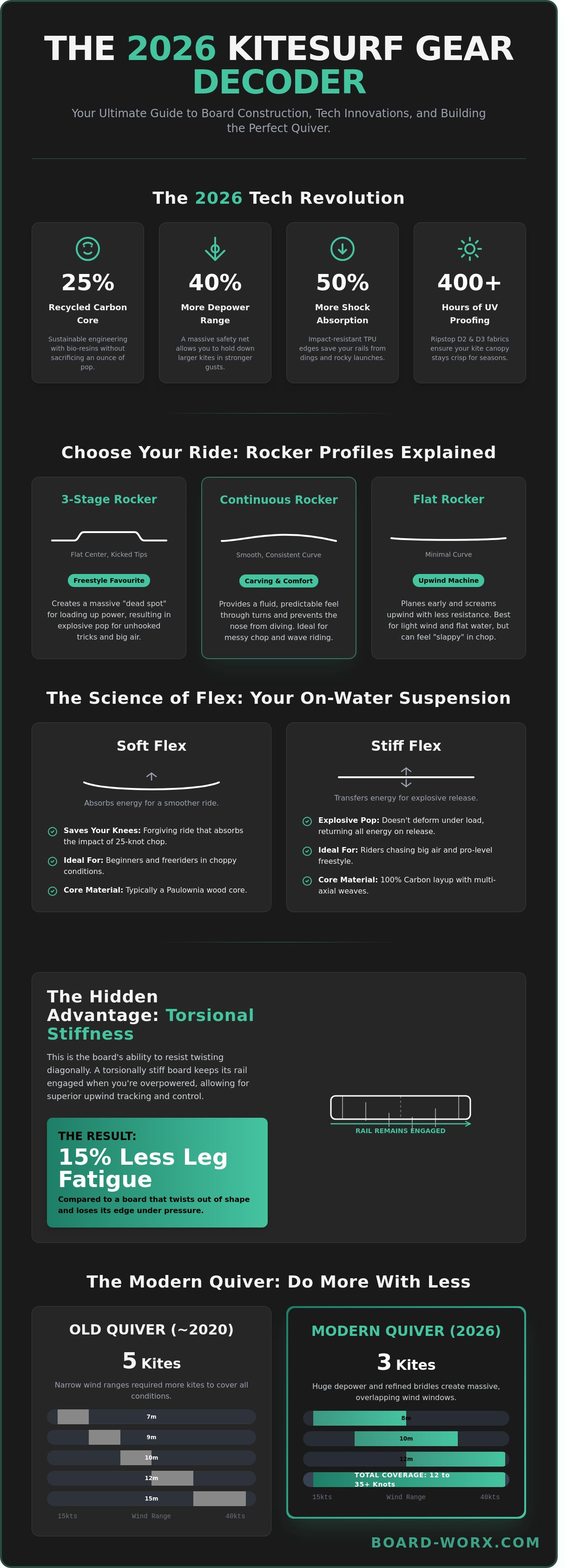
The 2026 season marks a total shift in how we approach the water. We've moved past the era of heavy, generic equipment into a period of total synergy between aerodynamics and hydrodynamics. Every kiteboard kitesurf setup hitting the shop floor this year is a precision instrument. Performance is no longer just about raw power; it's about how efficiently your kite talks to your board through the lines. We are seeing a massive push toward sustainable engineering, with 2026 models incorporating bio-resins and up to 25% recycled carbon cores without sacrificing an ounce of "pop."
Specialization has replaced the "one size fits all" mentality. While older gear tried to do everything passably, the current market demands gear that excels in specific niches. You'll notice a sharp divide between Freeride and Big Air designs. Modern kites now feature a depower range that is 40% more effective than models from five years ago. This massive safety net allows you to hold down a larger kite in stronger gusts, giving you the confidence to send it harder than ever before. It's about more time on the water and less time worrying about your gear's limits.
The Evolution of the Quiver
2026 kite designs have effectively killed the need for a five-kite garage. High-aspect ratios and refined bridle systems mean a single kite now handles a much wider wind window. Hybrid shapes have dominated the scene, blending the surf-carving ability of a directional with the explosive load-and-pop of a freestyle twin tip. The modern quiver is a three-kite system covering 12 to 35 knots.
Materials and Durability
Durability has taken a leap forward. Your 2026 board feels more responsive because of multi-axial carbon layups, where fibers are set at 30 and 60-degree angles to maximize energy return during take-off. We've also seen the industry-wide adoption of TPU edges. These impact-resistant rails absorb 50% more shock than traditional ABS, saving your rail from those inevitable car park dings or rocky launches. When you look at the canopy, Ripstop D2 and D3 fabrics are the gold standard. These materials are engineered to maintain their coating for over 400 hours of UV exposure, ensuring your kite stays crisp and airtight for seasons to come. Get ready to shred with gear that actually lasts.
Decoding Kiteboard Construction: Rocker, Flex, and Fins
Your board is the engine room of your session. While the kite provides the power, the board determines how you translate that energy into speed, pop, and upwind drive. Choosing the right kiteboard kitesurf setup requires looking past the graphics and into the core architecture. Every millimeter of curve and every layer of carbon changes how the water reacts under your feet. It's the difference between a smooth glide and a leg-burning struggle.
Rocker Profiles and Water State
Rocker is the longitudinal curve of your board from tip to tail. A flat rocker, typically under 35mm, is an efficiency machine. It planes early and screams upwind because it presents less resistance to the water. However, it can feel "slappy" in heavy chop. If you ride in the unruly waters of the UK south coast, a continuous rocker is often the better choice. It provides a smooth, predictable feel through the turns and prevents the nose from diving into the back of a wave.
- 3-Stage Rocker: This profile features a flat center with abrupt kicks at the tips. It is the freestyle favourite because it creates a massive "dead spot" for loading up pop.
- Continuous Rocker: Best for carving and comfort. It maintains constant contact with the water for a fluid ride in messy conditions.
The Science of Board Flex
Flex is your suspension system. A soft flex board, often built with a Paulownia wood core, absorbs the impact of 25-knot chop, saving your knees from long-term wear. Beginners benefit from this forgiveness as it smooths out mistakes. For riders chasing the moon, stiff carbon boards are the standard. A 100% carbon layup ensures the board doesn't deform under heavy load, resulting in an explosive release from the water.
If you want to feel the difference for yourself, check out our latest twin tips to find your perfect match.
Don't ignore torsional flex. This is the board's ability to twist diagonally. A board with engineered torsional stiffness will keep its rail engaged even when you're overpowered. This allows you to track upwind with 15% less leg fatigue compared to a board that twists out of shape and loses its edge. High-performance kiteboard kitesurf models use specific glass or carbon weaves to manage this twist without making the board feel like a plank.
Bottom shaping works in tandem with your fins. Deep 2mm channels act like mini-skegs, funneling water to provide grip without the drag of oversized fins. If you prefer a "skatey" feel for surface passes, stick to 35mm fins. For those boosting big air where landing stability is everything, 45mm or 50mm fins provide the "locked-in" sensation you need to ride away clean from a high-speed descent.
Kiteboard vs. Kitesurf Surfboard: Choosing Your Weapon
Your board is the physical interface between your feet and the raw energy of the ocean. Picking the right kiteboard kitesurf setup determines whether you're boosting 25-meter loops or carving a clean 6-foot face. Twin tips remain the symmetrical workhorses of the sport. They allow you to ride in either direction without shifting your feet, making them the undisputed choice for 95% of riders starting their journey or hitting the Big Air circuit. If you want to jump high, these boards offer the explosive pop and high-speed tracking you need.
The foil board has changed the game for light wind. By using a high-aspect carbon wing to lift the hull out of the water, you reduce drag by nearly 80%. This technology allows riders to cruise at 20 knots even when the wind barely hits 10 knots. It turns a "no-go" day into a high-performance session.
Construction is where the real tech hides. A dedicated kitesurf surfboard isn't just a surf shop board with straps. These boards feature high-density PVC foam cores and bamboo laminates to handle the 5x higher impact forces generated by kite power. A standard surfboard will often delaminate or snap under the constant pressure of a kite's pull; a kite-specific directional is built to be bomb-proof.
When to Stick with a Twin Tip
Twin tips are the king of versatility. You can switch directions instantly, which is vital in crowded lineups or tight flat-water spots. Most riders prefer a 135cm to 145cm length for general cruising. For Big Air, look for boards with heavy carbon layups. These provide the stiffness required to hold an edge in 35-knot gusts. Use a high-quality pad and strap system with 3D-molded footbeds to ensure your feet stay locked during inverted rotations.
Stepping into the Waves with a Directional
Stepping onto a directional board changes your perspective on the water. You stop looking for ramps and start looking for sections to shred. Sizing is closer to traditional surfing; a 5'8" or 5'10" board is common for average-sized riders. You have two main paths to take:
- Strapped Riding: Best for big wave security and learning to carve without losing the board in the chop.
- Strapless Riding: The ultimate test of skill. It offers a pure surfing feel and forces you to perfect your foot placement.
- Volume: Unlike twin tips, directionals rely on volume (usually 22L to 30L) to provide float and drive through turns.
The thrill of a "down-the-line" surf session with a kite is unmatched. You use the kite to pull you into the wave, then depower and let the board's shape do the work. It's the most authentic way to blend kiteboard kitesurf disciplines into one epic lifestyle.
Practical Guide: Matching Your Setup to National Wind Conditions
Getting your kiteboard kitesurf quiver dialed isn't just about grabbing the flashiest 2026 carbon layup. It's about physics. To maximize your time on the water, you need a setup that respects the local forecast and your specific physical profile. Most seasoned riders follow the 3-metre rule for their kite quiver. A standard two-kite setup usually consists of a 9m and a 12m kite. This 3-metre gap ensures you have enough overlap to stay powered without feeling dangerously over-cooked as the wind picks up. If you only have one kite, you're limiting your session window to about 30% of the flyable days in a typical season.
The Weight-to-Wind Ratio
A 75kg rider typically requires a 12m kite for 15-20 knot sessions. This is the sweet spot for most coastal conditions. If you're shredding in high-wind regions like the South Coast of the UK, you'll likely find an 8m or 9m kite becomes your daily driver. Conversely, inland riders dealing with lighter thermal breezes often rely on 15m or 17m light-wind machines. Don't fall into the trap of thinking a massive board is always better for light air. While a 145cm board offers more surface area for early planing, the increased drag can actually slow you down once you're moving. Apparent wind, which is the wind you generate through your own forward motion, means a smaller, more efficient board often performs better once you've reached planing speed.
Organising Your Gear for the Session
The UK coastline is unforgiving, and your accessories are what keep the stoke alive when the temperature drops. A 5mm wetsuit is the national standard for year-round riding, providing the essential thermal protection needed for 10-degree North Sea waters. Your harness is your most vital connection to the power of the kite. We recommend a hardshell model with dedicated lumbar support to prevent back fatigue during 3-hour sessions. It's the difference between walking off the beach or crawling off it.
- Line Checks: Inspect your bar and lines for knots or abrasions before every single launch. A 10% reduction in line strength can lead to a snap under high-load jumps.
- Pump Maintenance: Keep your session-saver ready by greasing the pump seals with silicone every 6 months to ensure smooth inflation.
- Buoyancy Aids: Never overlook a dedicated kitesurfing impact vest. It provides the necessary float if a line snaps 500 metres offshore and protects your ribs during heavy crashes.
Ready to build your dream high-performance quiver? Shop the latest kiteboard kitesurf gear at Board-Worx and get expert advice from riders who live for the water.
Why Boardworx is the Expert Hub for Your Next Session
Boardworx operates on a simple, rider-owned philosophy: if we wouldn't shred on it ourselves, it doesn't get a spot on our racks. We've spent over 20 years testing gear in the harshest UK conditions to ensure every kiteboard kitesurf setup we sell delivers the ultimate performance. Our selection for 2026 isn't just a random list of products; it's a curated collection of the best hardware from industry leaders like Duotone, North, and Airush. We dive deep into the technical specifications, analyzing carbon layup density in twin tips and the precise bridle geometry that dictates how a kite reacts in a powered-up loop.
Our commitment to the sport goes beyond just selling gear. We provide national delivery across the entire country, typically reaching riders within 24 to 48 hours. Whether you are chasing storms in Scotland or riding the thermal breezes in Cornwall, we ensure you have the right equipment to make every session count. We focus on technical excellence because we know that the difference between a mediocre day and an epic one often comes down to the millimeters in your board's rocker line or the weight of your kite's leading edge material.
Expert Advice from the Shop Floor
Generic product descriptions often miss the nuances of how gear actually feels on the water. Our team provides hands-on testing data that beats a factory spec sheet every time. We help you avoid the common trap of buying the wrong gear by offering personalized consultations based on your weight, local spot conditions, and riding style. If you're just starting out, check out our Beginner Kitesurfing Kites guide to find the most stable and forgiving 2026 models. We make sure your investment matches your progression speed.
The Boardworx Guarantee
Durability and high-end performance are our non-negotiable criteria for stocking any brand. We look for hardware that can withstand the 100% humidity and salt-heavy environments of the UK coast. By choosing Boardworx, you're tapping into a wealth of expert knowledge that supports the local kiteboard kitesurf community. We don't just ship boxes; we provide the technical support needed to tune your gear for maximum stoke. Ready to see the latest tech? Explore the full 2026 Kiteboard and Kitesurf range at Boardworx and prepare for your best season yet.
Lock in Your 2026 Performance Setup
The 2026 season brings massive shifts in kiteboard kitesurf technology. You've seen how specific carbon layups and refined rocker profiles now define high-performance riding. Whether you're chasing 30-knot gales with a high-flex twin-tip or carving 6-foot swells on a dedicated surfboard; your gear choice determines your success. Since 1982, we've tested every piece of kit that hits the water to ensure you get the perfect match for your local spot. Don't settle for "good enough" when you can ride the best.
Our team provides 100% expert technical advice on every product in the shop. We're rider-owned and operated, meaning we understand the stoke of a perfect session because we're out there with you. Plus, you get free UK delivery on all orders over £99. It's time to stop reading and start shredding with the most advanced tools available today.
Upgrade your quiver with the latest 2026 Kiteboards and Kites at Boardworx
See you on the water; let's make 2026 your most high-performance year yet.
Frequently Asked Questions
What is the difference between a kiteboard and a kitesurf board?
A kiteboard typically refers to a twin-tip board that is bidirectional, while a kitesurf board is a directional shape designed specifically for carving waves. Twin-tips are the choice for 85% of the community because they excel at freestyle and jumping. Directional boards resemble surfboards but use high-density foam and reinforced rails to handle 25-knot winds. Choosing the right one depends on whether you're chasing 10-meter boosts or carving up a 4-foot Atlantic swell.
Can I use a regular surfboard for kitesurfing?
You can ride a regular surfboard, but you'll likely snap the deck within 5 sessions because standard glassing isn't built for kite-specific loads. Standard surfboards use 4oz fiberglass which buckles under the 200lb of pressure created by a kite. Dedicated kiteboard kitesurf boards feature PVC sandwich layers and 6oz glassing to withstand hard landings. Stick to kite-specific tech to ensure your gear survives a heavy session at a local spot like Hayling Island.
What size kiteboard do I need for my weight?
Your weight dictates your board dimensions; a 75kg rider typically needs a 138cm x 41cm twin-tip for all-around performance. If you're a heavier rider over 95kg, you'll want to step up to a 142cm or 145cm board to maintain plane in 18-knot winds. Smaller boards offer 10% more control in high-wind gusts, but larger boards provide the surface area needed to stay upwind when the breeze lightens. Always check the manufacturer's specific size chart before buying.
How many kites do I need for a complete quiver in the UK?
A 3-kite quiver is the gold standard for UK riders facing unpredictable weather from Cornwall to Scotland. Most riders find that a 7m, 9m, and 12m setup covers a massive wind range from 15 to 38 knots. This 3-kite strategy ensures you never miss a session because of a 5-knot difference in the forecast. If you're on a budget, a 2-kite quiver consisting of a 9m and 12m handles 70% of typical 18-25 knot days.
Is a carbon kiteboard worth the extra money?
Carbon kiteboards are absolutely worth the investment for riders seeking 20% less weight and superior pop off the water. The increased stiffness of a carbon layup allows for immediate energy transfer, giving you 2 or 3 extra meters of height on your jumps. While they cost roughly £200 more than glass boards, the performance gains in light wind and the crisp feel underfoot make every session feel 100% more responsive and energetic.
What is the most versatile kite shape for a beginner-intermediate rider?
A 3-strut hybrid or Delta-C shape is the most versatile option for 90% of beginner-intermediate riders. These kites offer a massive wind range and 100% depower, making them safe when a 30-knot gust hits. They also feature swept-back wingtips that make water relaunching nearly automatic in under 5 seconds. It's the ultimate design for building confidence while you're learning to transition or trying to stick your very first backroll without stress.
How often should I replace my kitesurfing lines and bar?
You should replace your lines every 100 sessions or every 12 to 18 months to avoid catastrophic failure mid-jump. Salt and UV rays degrade the Dyneema fibers, reducing their 400kg breaking strength by up to 30% over a single season. Check your depower line for fraying every 10 sessions. Spending £150 on a fresh set of lines is a small price to pay for peace of mind when you're 10 meters in the air.
Do I need a different board for flat water and waves?
You definitely need different boards to get the most out of flat water lagoons and 5ft coastal waves. Flat water boards feature a low 3cm rocker for maximum speed and upwind tracking, whereas wave boards require a 5cm rocker to prevent the nose from digging in. Using a dedicated kiteboard kitesurf directional in the surf gives you the 100% rail-to-rail control needed to shred a wave face properly without losing your edge.