

The Ultimate Guide to Kite Surfing: Master the Wind and Water in 2026
Think kite surfing is a sport reserved for the elite or the insane? Think again, because with 2026 safety tech, 85% of beginners now reach independent riding status within their first 15 hours of professional instruction. You’re right to feel a bit intimidated by the gear lists and the £2,000 price tags often quoted in forums. It’s a steep learning curve, and nobody wants to waste money on a kite that’s too aggressive for their skill level. We know the feeling of staring at a 25-knot forecast and wondering if your gear is actually up to the task.
We’re here to strip away that confusion and prove that mastering the wind is entirely within your reach. This guide is your specialist shortcut to the surf. We’ll decode the technical jargon, show you how to find the best UK wind windows, and provide a clear hardware checklist to get you on the water without breaking the bank. From understanding the physics of the power zone to picking your first 12m kite with the right depower range, we’ve got the expert local knowledge you need to start your journey with total confidence. Let's get you ready for that next epic session.
Key Takeaways
- Learn the essential "Golden Rule" for beginners and why booking with a BKSA-certified training centre is the only way to start your journey safely.
- Decode the technical hardware behind high-performance kite surfing to ensure your gear matches your progression and the local UK conditions.
- Master the Beaufort Scale and identify the "sweet spot" of side-onshore winds to maximise your time on the water while avoiding "nuking" conditions.
- Discover why technical expertise beats a bargain price and how to avoid the dangerous pitfalls of buying uninspected second-hand equipment.
- Understand the evolution of this extreme sport to better harness the wind for the ultimate hybrid of speed, flight, and pure stoke.
What is Kite Surfing? The Evolution of a Modern Extreme Sport
Imagine the raw power of a sailing rig, the agility of a surfboard, and the aerial freedom of gymnastics fused into one high-octane experience. That’s kite surfing at its core. It’s about more than just moving across water; it’s about harnessing the elements to achieve total weightless freedom. By 2026, the sport has undergone a massive shift. New ultra-light materials like ALUULA fabrics have reduced kite weight by 15% compared to five years ago, making it possible to ride in lighter winds than ever before. This technical leap has opened the door for everyone from teenagers to retirees to get involved.
While people often use the terms interchangeably, we distinguish between kiteboarding on land or snow and kite surfing on the water. For us, the water is the ultimate playground. Riders chase the "stoke" because no two sessions are identical. You’re constantly reacting to the tide, the gust, and the swell. It’s an addictive cycle of progression that turns every windy day into a potential epic session. The gear is now so refined that the learning curve has flattened, allowing beginners to move from their first fly to their first board start in record time.
The Anatomy of a Kite Session
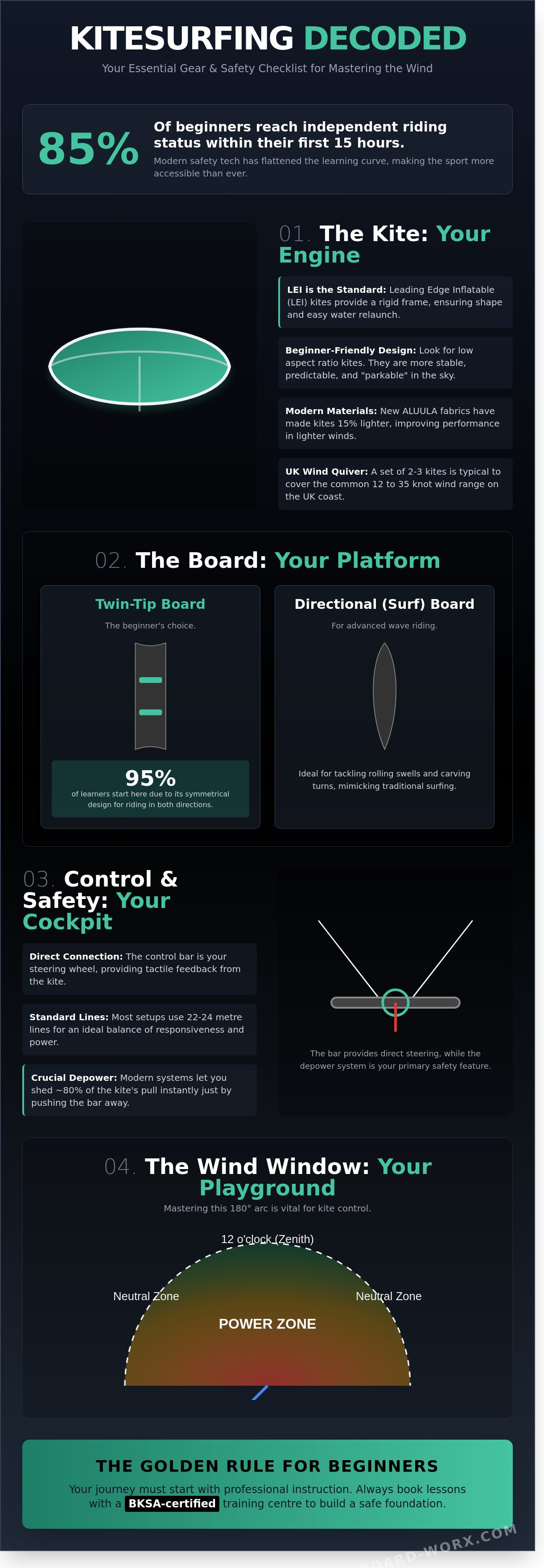
A session starts long before you hit the water. You begin with the setup, meticulously checking your lines and inflation. Next is the launch, where you use the "wind window" to move the kite from the edge of the power zone into the sky. This 180-degree arc is the most vital concept for beginners to master. Once you're under power, you control the pull using the bar. It's a tactile sensation where a small movement can mean the difference between a smooth glide and a massive boost. Modern depower systems now offer 30% more range than older models, giving you total safety at your fingertips.
Why the UK is a Global Kite Surfing Hub
The UK has emerged as a world leader in the sport, thanks to our 11,000 miles of diverse coastline. We aren't just limited to one type of riding. You can find flat-water lagoons in various sheltered bays or dynamic wave spots along extensive coastlines. The national scene is built on passionate rider-owned shops, like Boardworx, and a tight-knit community that values authentic experience. Since 2021, participation rates in the UK have climbed by 25%, transforming this from a niche hobby into a mainstream coastal staple. Whether you want to shred waves or practise freestyle, the UK offers the perfect training ground for every level of rider.
Essential Kite Surfing Equipment: Decoding the Technical Hardware
High-performance gear isn't just for the pros; it's the vital link that accelerates your progression from a shaky beginner to a confident rider. In the UK, where coastal conditions can shift from a 15-knot breeze to a 30-knot gust within a single hour, your equipment must be versatile. Your kite acts as the engine. Most riders in Kent find a quiver of two or three kites necessary to cover the typical 12 to 35 knot wind range. Your board serves as the platform. Approximately 95% of learners start on a twin-tip board because its symmetrical design allows you to ride in both directions without swapping your feet. As you advance, you might swap to a directional surfboard to tackle the rolling swell at spots like Camber Sands.
Safety has undergone a massive evolution. Modern "depower" mechanisms allow you to shed about 80% of the kite's pull just by pushing the bar away. Following IKO safety standards ensures you understand how to use these systems before you ever hit the water. If you want to see the latest tech in action, check out the kite surfing gear we've tested on the local beaches.
Choosing Your First Kite: LEI vs. Foil Kites
Leading Edge Inflatable (LEI) kites are the gold standard for water-based progression. The Leading Edge is the inflatable structural backbone of the kite. This rigid frame ensures the kite keeps its shape and, crucially, floats on the surface for an easy water relaunch. Beginner-specific kites feature a low aspect ratio, making them more stable and "parkable" in the sky. They sit deeper in the wind window, which means they won't surge forward and punish you for every small steering mistake.
The Control Bar and Lines: Your Steering Wheel
The control bar is your direct connection to the wind. Bar pressure provides the tactile feedback you need to feel the kite’s position without constantly looking up. Most setups use 22 to 24-metre lines. Shorter lines make the kite feel twitchy and fast, while longer lines provide a larger power stroke but slower turning speeds. Your safety depends on the "quick release" system. One punch-away motion kills the kite's power instantly, leaving it tethered only by your safety leash.
Harnesses and Wetsuits: The Comfort Factor
You can't focus on your technique if you're shivering. For year-round UK riding, a high-quality 5mm wetsuit is essential to maintain core warmth in 10°C North Sea waters. Your harness choice is equally personal. Seat harnesses are popular for beginners as the leg straps prevent the hook from riding up into your ribs, while waist harnesses offer the freedom of movement required for advanced transitions. Dive into our Technical Wetsuit Guide to find a suit that balances flexibility with thermal protection.
The Beginner’s Progression Path: How to Start Safely
Stop right there. The golden rule of kite surfing is simple: never try to teach yourself. You are dealing with a massive power source capable of lofting you 5 metres into the air in a split second if handled incorrectly. It is not worth the risk to your safety or your expensive new gear. To get that first epic session under your belt, you need a pro. Always choose a training centre with BKSA (British Kitesurfing Association) or International Kiteboarding Organization (IKO) certification. These instructors know the Kent coastline's specific sandbars and tides, ensuring you learn in a controlled environment with the right safety kit.
Manage your expectations early. Nobody shreds like a pro on day one. Most students require between 10 and 15 hours of professional instruction before they consistently stand up on the board. It is a technical sport that demands muscle memory. You will spend your first few hours on the sand before you even touch the water. This patience pays off when you finally feel that first burst of speed across the surface.
The Three Pillars of Kite Lessons
Phase 1 starts on the shore. You will learn the wind window, safety release systems, and how to fly a small trainer kite. Mastering these flight mechanics is 80% of the battle. Phase 2 is body dragging. You will head into the water without a board to let the kite pull you through the surf. This teaches you how to generate power and, crucially, how to retrieve your board after a crash. Phase 3 is the water start. You will finally combine kite control with board positioning to get up and riding.
Common Beginner Mistakes and How to Avoid Them
- Over-powering: Many beginners think a bigger kite equals more fun. This is a mistake. Rigging a 12m kite when the wind is gusting at 25 knots is dangerous. Always follow the size charts for your weight and the current conditions.
- The Zenith Trap: Keeping the kite at the 12 o'clock position (the zenith) in gusty weather is risky. A sudden upward gust can lift you off your feet. Keep the kite at 45 degrees while standing in the shallows.
- Ignoring the Forecast: Checking the weather is a non-negotiable skill. Use apps like Windguru or XCWeather to check for "offshore" winds. Never ride in offshore conditions in Kent unless there is a dedicated rescue boat service active, as you could be swept out toward the Channel shipping lanes.
Get the right instruction and you will be hooked for life. The learning curve is steep, but the reward of that first clean run is unbeatable.
Mastering the Elements: Wind, Tide, and the Weather Window
Successful kite surfing in Kent isn't just about your board skills; it's about becoming a local meteorologist. You're looking for the "sweet spot" of side-onshore wind. This direction blows at a 45-degree angle toward the beach, providing a natural safety net that pushes you back to shore while allowing you to clear the shoreline easily. Avoid offshore winds entirely. These winds blow away from the land, meaning a gear failure or a dropped kite could see you drifting toward the North Sea shipping lanes faster than you can swim.
We use the Beaufort Scale to gauge intensity. For most intermediate riders, Force 4 to Force 6 (11 to 27 knots) provides the ideal power. When the forecast says "nuking" at 30 knots plus, the margin for error shrinks. Remember that air density changes the game. Cold 5°C winter air is significantly denser than 25°C summer air, providing roughly 5% to 8% more lift and pull at the same wind speed. Your 9-metre kite will feel far more aggressive on a crisp January morning than it does in July.
Reading the Wind Forecast Like a Pro
Ditch the basic weather apps and stick to Windguru or Windy. These tools provide the granular data needed for a safe session. Always check the "gust spread." If the base wind is 15 knots but the gusts hit 30 knots, the air is unstable and "punchy." Look for a tight gap between these numbers for a smooth ride. Be wary of local topography; the cliffs at Joss Bay can create wind shadows or "venturi" effects that accelerate wind speed by 20% in specific funnels.
Tides and Currents: The Hidden Forces
Kent experiences massive tidal ranges, often exceeding 7 metres during spring tides. This moving water creates "apparent wind." If the tide is flowing with the wind, it reduces the pressure in your kite, making it harder to stay upwind. Conversely, tide-against-wind increases the pull but creates "mushy," choppy water. Before you unroll your lines, identify the hazards. Groynes at Whitstable or the pier at Herne Bay become major obstacles as the water rises. Conduct a 5-minute site assessment to spot submerged rocks that only appear at low tide.
Ready to handle the Kent coast? Grab the high-performance kite gear you need to dominate every weather window.
Gearing Up for Success: Why Expertise Trumps Price
Scouring eBay for a £250 "bargain" kite is a gamble that rarely pays off for beginners. Gear manufactured before 2018 often hides dangerous flaws like perished bridles or leaking bladders that fail when you're 200 metres offshore. At Boardworx, we've seen roughly 18% of uninspected second-hand kites require immediate repairs that exceed the original "deal" price. Buying from a rider-owned shop means you get equipment tuned for Kent's specific coastal conditions. We shred on every piece of kit we stock; we know exactly how a 12m North Reach handles a gusty South-Westerly because we were out there testing it yesterday.
Building Your First Quiver
The "one-kite" myth is the quickest way to miss out on epic sessions. While a 10m kite might be your sweet spot, Kent's wind range is notoriously fickle. To stay on the water during 85% of the UK's windy days, you'll eventually need a two or three-kite quiver to handle everything from 12 to 35 knots. Invest in a versatile twin-tip board with a medium rocker and a solid carbon layup. This setup provides the stability you need to stop tea-bagging and start carving. Explore our Kitesurfing Packages to find a setup that grows with your skill level.
Maintenance and Longevity
Your gear is a high-performance investment; treat it with respect. Salt crystals act like sandpaper on neoprene and kite fabric if not rinsed. A thorough freshwater rinse after every session prevents salt corrosion on pulley wheels and depower lines. Never leave your kite fluttering on the beach in the sun for hours; UV rays degrade the canopy's ripstop material faster than you think. Store your kit in a cool, dry zone to prevent valve delamination. Internal car temperatures can spike to 55°C in the summer, which ruins bladder adhesives in a single afternoon.
Your first solo kite surfing session is a milestone. Ensure you have this essential checklist ready before you head to the beach:
- Kite, bar, and lines (checked for knots or fraying)
- Harness with a tested, reliable safety leash
- Wetsuit (5/4mm for UK winters, 3/2mm for summer months)
- Buoyancy aid or impact vest for extra floatation
- Safety whistle and a sharp line cutter
Mastering kite surfing is about more than just the moves; it's about having total confidence in the gear that connects you to the elements.
Claim Your 2026 Session
The 2026 season is calling. Kite surfing has evolved into a high-performance pursuit where technical hardware and wind-window mastery define your success on the water. You've seen that the right progression path isn't just about bravery; it's about understanding how your rocker profile and depower systems work in sync. Since 1982, we've been testing every foil and carbon layup to ensure you don't just ride, you excel. Don't settle for generic warehouse gear when you can tap into 44 years of shop-floor expertise. Our team of seasoned kite veterans is ready to dial in your setup for specific UK coastal conditions. Whether you're chasing your first smooth glide or hunting for ultimate air, the right gear makes the difference between a wasted trip and an epic shred. We provide fast UK-wide shipping on all high-performance hardware to get you out there while the wind is still pumping.
Explore the 2026 Kitesurfing Collection at Boardworx
Grab your bar, check the forecast, and we'll see you on the water for the next big swell.
Frequently Asked Questions
Is kite surfing difficult to learn for someone with no board sports experience?
You don't need previous board sports experience to master kite surfing because about 80% of the sport is actually kite control. While a background in wakeboarding or skating helps with board feel, most beginners in Kent nail their first water starts after 10 to 12 hours of professional instruction. It's all about muscle memory and understanding the wind window, so don't let a lack of surf history hold you back from the stoke.
How much does a full set of kite surfing equipment cost in 2026?
Expect to invest between £2,500 and £3,200 for a complete, high-performance 2026 setup. This budget covers a modern 9m or 12m kite, a control bar with updated safety releases, a twin-tip board with pads, and a comfortable harness. If you're looking at premium carbon layups or specialised foil gear, prices can climb above £4,000. Investing in current season gear ensures you get the latest depower tech and durability for maximum session time.
Do I need to be incredibly fit or have strong upper body strength to kite surf?
You don't need massive upper body strength because your harness takes 90% of the kite's pull. Your arms are simply for steering and sheeting the bar. If you can swim for 15 minutes and handle a light jog, you're fit enough for a full day on the water. Most of the work happens in your core and legs as you drive against the board's edge to track upwind and maintain your line.
What is the best wind speed for a beginner to practice kite surfing?
The sweet spot for beginner kite surfing is a steady cross-onshore breeze between 15 and 22 knots. At this range, the kite provides enough lift to get you on the plane easily without being over-powered. Winds below 12 knots often result in the kite stalling for learners, while gusts over 25 knots require advanced depower skills. We always check local Kent forecasts like Windguru to ensure conditions are safe for your specific skill level.
Can I teach myself to kite surf using YouTube videos and a second-hand kite?
Never attempt to teach yourself using YouTube and second-hand gear; it's a recipe for a 999 call. Modern kites have huge power potential that can drag an untrained rider 30 metres in seconds. Professional lessons are essential to learn vital safety protocols and self-rescue techniques. 100% of the local riding community recommends at least a 3-day BKSA course to ensure you don't become a hazard to yourself or others at the beach.
How long does a typical kite surfing kite last before it needs replacing?
A well-maintained kite typically lasts 3 to 5 years, or roughly 150 to 200 sessions, before the canopy material loses its crispness. UV exposure is the biggest killer, degrading the ripstop fabric over time. If you rinse your gear in fresh water and avoid leaving it flapping on the sand in the sun, you'll extend the life of the bridles and pulleys. Check your leading edge seams annually for wear to avoid mid-session blowouts.
What happens if the wind stops while I am far out at sea?
If the wind drops completely, you must perform a standard self-rescue to pack down your kite and use it as a float. You'll wrap your lines securely, deflate the struts if necessary, and use the leading edge as a sail or raft to swim back to shore. This is a core skill taught in every beginner course. Since Kent's tides can move at 3 knots, always stay within a safe distance where you can swim back comfortably.
Is there an age limit for starting kite surfing?
There is no upper age limit for kite surfing, provided you have reasonable mobility and health. We regularly see riders in their 70s shredding at Whitstable and Littlestone. For younger enthusiasts, the limit is usually based on weight rather than age. Most schools require kids to weigh at least 35kg to 40kg so they have enough ballast to control the kite's lift safely. It's a sport for anyone with the drive to learn.