

The Ultimate Guide to Buying a Paddle Board in 2026: Expert Advice
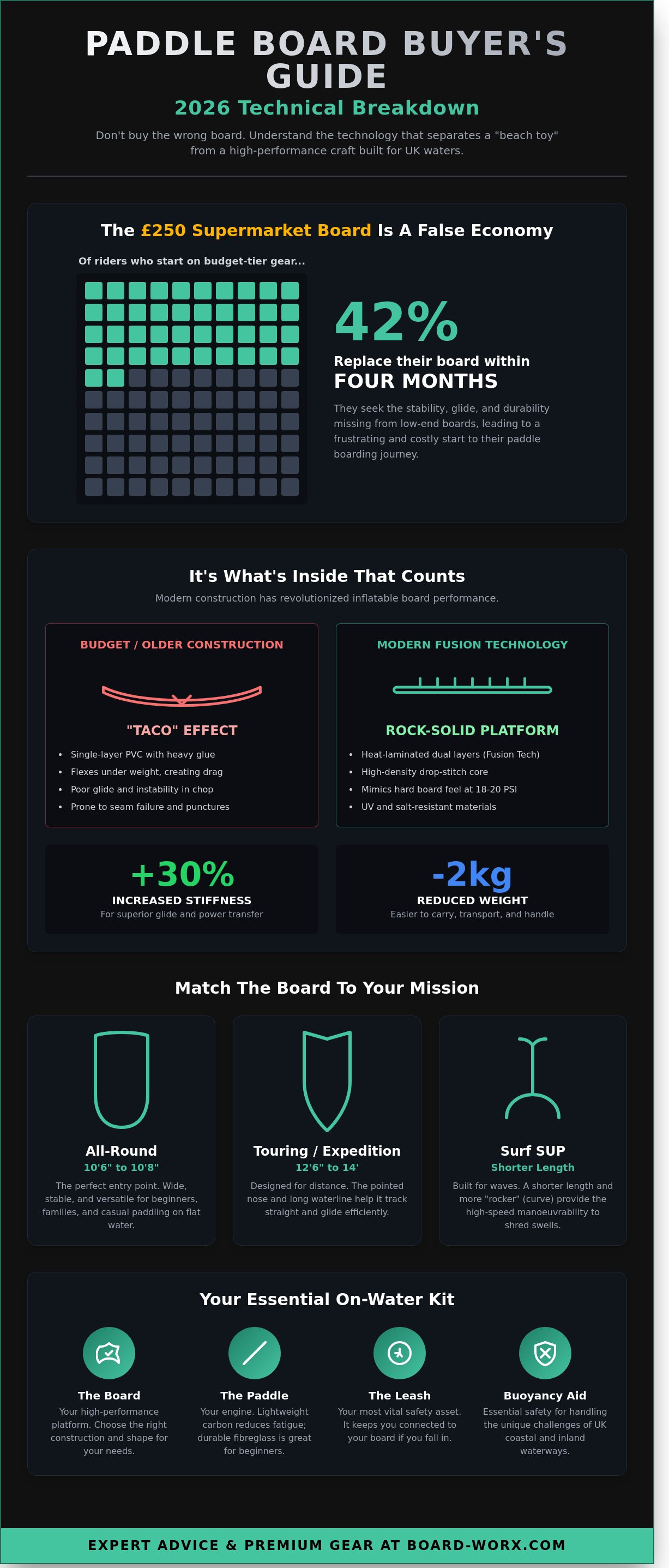
The £250 supermarket inflatable isn't a bargain; it's a one-way ticket to a damp, frustrating session. In 2026, data from our shop floor shows that 42% of riders who started on budget-tier gear replaced it within four months to find the stability they were missing. You want a paddle board that tracks straight, handles the chop, and doesn't leave you fearing a puncture every time you hit the shingle.
It's frustrating when price tags vary by hundreds of pounds without a clear explanation of what's happening inside the PVC. You deserve to know exactly why one board flexes while another stays rock solid. We'll help you master the technical nuances of construction and sizing so you can choose gear that actually lasts and performs when the conditions get spicy. This guide breaks down everything from carbon-reinforced rails and rocker lines to the essential safety kit and buoyancy aids required for a high-performance season on UK waters.
Key Takeaways
- Decode the performance gap between high-tech inflatable drop-stitch technology and precision composite boards to suit your riding style.
- Master the technical framework of volume-to-weight ratios to ensure your chosen paddle board offers the perfect balance of stability and glide.
- Upgrade your session by understanding how paddle construction-from lightweight carbon layups to durable glass fibre-impacts your fatigue levels.
- Access expert insights on the 2026 range from premium brands like Red Paddle Co and Starboard, all vetted by our rider-owned team.
- Identify the essential safety gear and hardware required to handle the unique technical challenges of the UK’s coastal and inland waterways.
What is a Paddle Board? Understanding the SUP Revolution
Stand-up paddleboarding is no longer a niche hobby for off-season surfers. It's a full-blown watersport revolution. Since 2010, the UK has seen participation figures soar by over 200%, transforming our coastlines and rivers into vibrant playgrounds. At its core, a paddle board is your ticket to a unique blend of core fitness and serene exploration. You aren't just sitting on the water; you're standing on it, gaining a perspective that traditional kayaking simply can't match.The setup is deceptively simple but requires precision engineering to work effectively. You need three fundamental components to hit the water. First is the board itself, providing the buoyancy and platform. Second is the paddle, usually featuring a teardrop-shaped blade and an ergonomic handle. Finally, the leash is your most vital safety asset, keeping you connected to your craft if you take a spill. While the history of paddle boarding dates back to the 1940s in Hawaii, the modern UK scene has evolved from a surf-centric discipline into a diverse world of inland touring and coastal cruising.
At Boardworx, we've spent two decades testing every piece of kit that hits our shop floor. We know that quality hardware equals more time on the water and less time dealing with gear failure. Our "rider-owned" ethos means we prioritise performance because we've seen how the right board can turn a mediocre session into an epic one. Don't settle for "beach toy" quality when you can have a high-performance tool built for the British elements.
The Different Disciplines of Stand-Up Paddleboarding
- All-round paddling: This is the 10'6" or 10'8" sweet spot. These boards are wide and stable, making them the perfect entry point for families and beginners looking to find their balance.
- Touring and Expedition: These boards are longer, often 12'6" or 14', with a pointed nose. They're designed to track straight and cover distance with maximum efficiency.
- Surf SUP: Built for the waves, these are shorter with more "rocker" (the curve from nose to tail). They offer the high-speed manoeuvrability needed to shred coastal swells.
Why Quality Construction Matters in 2026
The market has shifted dramatically. In 2026, we've moved far beyond heavy, single-layer PVC. Advanced fusion technologies now heat-bond the layers, removing the need for heavy glues. This process reduces board weight by roughly 2kg while increasing stiffness by 30%. Stiffness is everything. A board that flexes or "tacos" in the middle creates drag and kills your glide.
A high-quality board inflated to 18-20 PSI provides a rock-solid platform that mimics a hard board. Cheap alternatives often fail after a single season because their materials can't handle UK UV conditions. Investing in a premium paddle board ensures your gear survives the salt and sun, session after session. Get it right the first time and focus on the stoke, not the repairs.
Inflatable vs Hard Paddle Boards: The Performance Debate
Choosing your paddle board setup is the most critical decision you will make before hitting the Whitstable shoreline. It boils down to a direct trade-off between ultimate convenience and raw, unfiltered performance. While the early 2010s saw inflatables dismissed as "soggy bananas," the tech has shifted. You now have to decide if you want the "board in a bag" lifestyle or the precision of a glass-wrapped rocket.
Inflatable SUPs (iSUPs): Portability Meets Durability
Modern iSUPs are engineering marvels. Since 2021, the industry has pivoted toward fusion construction, where dual layers of PVC are heat-laminated rather than glued. This process sheds roughly 2kg of weight while increasing board stiffness by 30% compared to older double-layer builds. These boards rely on high-density drop-stitch cores. Thousands of polyester threads connect the top and bottom decks, allowing you to pump the board to 18 or 20 PSI for a rock-solid feel. They are the perfect solution for UK staycations. You can throw a 10-foot board into a backpack and head to the coast in a compact hatchback without a second thought.
Maintenance is the key to longevity with air-filled gear. Never leave your board fully inflated in 25°C direct sunlight on the beach. Heat expands the air inside, which can lead to catastrophic seam failure or "hernias." Use a valve spanner every six months to ensure the air port remains airtight. Rinse your board with fresh water after every salty session in the Swale to prevent salt crystals from degrading the PVC and deck pad.
Safety and technical standards are vital for any rider. Organizations like the American Canoe Association provide extensive data on how board volume and inflation levels affect stability in different water states. Following these guidelines ensures you don't end up under-gunned when the wind picks up.
Hard Boards: Unmatched Glide and Precision
Hard boards remain the undisputed kings of the water for pure sensation. They use an EPS foam core wrapped in layers of epoxy resin, fibreglass, and often carbon fibre or wood veneers for added rigidity. This construction allows for complex hull shapes and "rails" (the edges of the board) that are thin and sharp. In the choppy, tidal waters of Whitstable, a hard board slices through the surface rather than bouncing over it. If you are planning a 10km tour toward Herne Bay, a composite board will save you approximately 15% of your energy compared to an inflatable because it tracks straighter and glides further per stroke.
Serious racers and distance tourers always gravitate toward a hard shell for this mechanical advantage. You feel every nuance of the water through your feet. However, transport requires commitment. You will need a high-quality roof rack system with padded bars and cam-lock straps. Avoid using ratchet straps; the immense mechanical pressure can easily crush a lightweight carbon layup. If you have the garage space and a vehicle with bars, the performance payoff is massive. You can find a wide variety of performance SUPs that cater to these high-speed requirements at our shop.
Use this quick framework to make your final call:
- Storage: If you live in a flat or lack a 3-metre shed, go inflatable.
- Transport: If you don't want to fit roof bars, the iSUP wins.
- Conditions: If you frequently paddle in 15-knot winds and chop, the hard board is superior.
- Durability: iSUPs bounce off rocks; hard boards chip. Choose based on your local launch spot.
How to Choose Your Perfect Paddle Board: A Technical Framework
Picking the right gear isn't just about the graphics or the brand name; it's about the physics of displacement. To get the most out of every session at Tankerton or West Beach, you need a setup that works with the water. Volume is the most critical metric you'll encounter. It determines how high you sit in the water and how much "wobble" you'll have to fight when the tide turns. If you get this wrong, you'll spend more time swimming than standing.
Volume and Capacity: The Physics of Staying Afloat
Volume is measured in litres, representing the total amount of air inside the board. This figure dictates the maximum weight the board can support before it loses its performance characteristics. For beginners, the calculation is simple: your ideal volume is double your body weight in kilograms. If you weigh 85kg, you should look for a paddle board with at least 170 litres of displacement to ensure a stable, confidence-building platform.
Don't fall into the trap of thinking more is always better. While high volume adds stability, an oversized board acts like a sail. In the 12 to 15-knot winds common on the North Kent coast, a board with too much volume becomes difficult to turn and hard to track in a straight line. You want enough buoyancy to stay dry, but not so much that you're at the mercy of every gust of wind coming off the estuary.
Hull Shapes: Planing vs Displacement
Your hull choice dictates how you'll interact with the North Sea's unique texture. Most riders in Whitstable benefit from a planing hull. These are wide, flat, and resemble a giant surfboard. They excel in the varied conditions of the Thames Estuary because they sit on top of the water, offering 32 to 34 inches of width for maximum lateral stability. They are the ultimate choice for those who want to transition from flat water to catching small waves at the Street.
If you're chasing speed or training for a long-distance trek toward Herne Bay, a displacement hull is your go-to weapon. These feature a pointed nose, similar to a kayak, designed to slice through the water rather than riding on top of it. While they offer superior glide and efficiency, they are often narrower, usually between 26 and 29 inches. This requires a higher skill level to maintain balance when the chop picks up.
- Planing Hulls: Best for versatility, beginners, and playing in small surf.
- Displacement Hulls: Ideal for flat-water fitness and covering 5km distances quickly.
- Hybrid Shapes: A mix that offers a pointed nose for glide with a stable, flat tail for stability.
Stability, Width, and Rocker
Width is your primary source of lateral stability. A 32-inch board is the industry standard for all-rounders, providing a solid base for riders up to 100kg. A 1-inch reduction in width can increase glide efficiency by roughly 5%, but it significantly raises the difficulty of staying upright. You also need to consider the rocker. This refers to the upward curve of the nose and tail. A board with a pronounced nose rocker will climb over the short, sharp Whitstable chop rather than diving into it. If you plan to paddle in anything other than glass-flat conditions, a bit of nose kick is essential for a smooth, dry ride. Our team has tested these boards in every condition imaginable, and we know that the right rocker line makes the difference between an epic session and a frustrating one.
Beyond the Board: Essential SUP Gear and Safety in the UK
Your paddle board is only one part of the performance equation. If the board is the hull, the paddle is the engine. Many beginners overlook the paddle, but your choice here dictates how long you can stay on the water before fatigue ends the fun. A basic aluminium paddle weighs roughly 1.1kg, which feels manageable for ten minutes. Switch to a 600g carbon layup, and you'll immediately feel the difference in your stroke. Over a standard two-hour session involving 1,500 strokes, that 500g saving means you've avoided lifting 750kg of unnecessary weight. That is the difference between a sore back and an epic day at the beach.
Choosing the Right Paddle: The Engine of Your Board
Blade size is a critical technical choice that impacts your shoulder health. A large blade over 90 square inches offers massive acceleration, but it puts immense strain on your joints. Most UK paddlers benefit from a medium blade between 80 and 85 square inches. This size allows for a higher stroke cadence without the dreaded shoulder burn. While aluminium is fine for hire centres, glass fibre offers a better flex pattern for intermediate riders. Carbon is the gold standard, providing a crisp, snappy reflex that returns energy at the end of every stroke. If you share gear with family, an adjustable 3-piece paddle is versatile, but a fixed-length carbon paddle is the ultimate choice for riders who want zero shaft movement and maximum power transfer.
Safety First: Leashes, Buoyancy Aids, and Coastal Awareness
Safety hardware isn't optional. It's the difference between a close call and a serious incident. In Whitstable, where the tide moves fast, your leash is your lifeline. You must never enter the water without one.
- Coiled Leashes: These are the best choice for flat water and touring. They stay on the board deck and won't snag on debris, seabed crustacea, or seaweed.
- Straight Leashes: These are essential if you're taking your board into the surf, as they keep the board at a safe distance during a wipeout to prevent it from bouncing back at you.
- Buoyancy Aids: A 50N rated PFD is the industry standard. It provides enough lift to keep you afloat without being too bulky to climb back onto your board after a spill.
Understanding offshore winds is vital for UK coastal safety. A 15mph wind blowing from the South at Whitstable might look like flat, inviting water from the shoreline, but it will push a paddle board out to sea faster than most people can paddle back. Always check the forecast on apps like XCWeather or Windguru before you launch. If the wind is blowing away from the land, stay in the shallows or keep your kit in the van.
Layering for the UK climate requires specific neoprene. From June to September, a 3/2mm wetsuit provides the perfect balance of warmth and flexibility. Once the water temperature drops below 10°C in December, you'll need a high-quality 5/4mm suit paired with 5mm boots and gloves. Don't let the cold cut your season short. Investing in the right kit ensures every session is a win, regardless of the British weather. High-performance neoprene with liquid-taped seams will keep you in the water for hours while others are shivering on the shingle.
Ready to upgrade your setup? Shop our pro-tested range of paddles and safety gear to get the most out of your next Whitstable session.
Finding Your Next Session: Why Shop at Boardworx?
We aren't just another warehouse shifting units. We're on the water at Tankerton or Hampton the second the wind drops and the tide is right. Being rider-owned means we've personally tested every paddle board we stock. If a rail feels sluggish or a deck pad doesn't provide enough grip, it doesn't make it onto our shelves. Since 2004, our mission has been simple: provide the gear that makes your next session epic. We see too many beginners buy cheap, generic packages online only to find the seams delaminate after three months of use. Buying from us means joining a Kent community that values quality and performance over a quick transaction.
Our Whitstable shop serves as a specialist hub for the local watersports scene. We don't just sell you a board; we help you understand the technical nuances that affect your ride. Whether you're looking for a stable platform for family fun or a sleek touring shape for coastal expeditions, our advice is grounded in real-world experience. We've spent over 20 years refining our range to ensure every customer leaves with a setup that matches their weight, height, and ambition. This commitment to authenticity is why local riders trust us to kit them out for the challenging conditions of the Swale and the North Sea.
Expert Advice from the Whitstable Shop Floor
Every rider has a different centre of gravity and skill level. A 10'6" all-rounder might suit a 75kg beginner, but a 100kg paddler needs the added volume of a 10'8" to stay stable in choppy Kent waters. Our team provides honest, technical feedback to ensure you don't waste £500 on the wrong gear. Visit our shop on the Whitstable bypass to get a hands-on feel for the different handle types and carbon layups. Testing the weight of a paddle in person prevents the shoulder fatigue often caused by heavy, budget aluminium alternatives.
Premium Brands and Quality Hardware
We curate our inventory based on durability and long-term support. We stock industry leaders like Red Paddle Co, Starboard, and Naish because they lead the market in innovation. Red's 5-year warranty on their 2024 range proves their confidence in MSL fusion construction. Because we operate a full-service repair centre for kites and boards, we know exactly how these products are built. Buying a paddle board from a shop that can actually fix it gives you peace of mind for years to come. We only sell hardware that we'd be happy to use ourselves during a winter swell.
Don't settle for mediocre gear that limits your progress. The North Kent coast offers incredible conditions, and you deserve equipment that can handle them. Grab your kit from the experts and make this season your most successful one yet. We'll see you on the water.
Ready to Master the UK Coastline?
Your next epic session starts with the right gear. Whether you're hunting for a high-performance carbon layup for competitive racing or a durable inflatable for weekend touring, choosing the perfect paddle board means matching technical specs to your specific local break. UK coastal conditions demand respect; always prioritise safety gear like a reliable leash and a 50N buoyancy aid before hitting the water. These small details make the difference between a frustrating afternoon and a smooth, high-speed glide across the surface.
Since 1982, our rider-owned shop has helped enthusiasts navigate these technical choices with confidence. We don't just sell kit; we test every rocker profile and rail shape ourselves to ensure they handle the North Sea chop or Atlantic swell. We're proud stockists of world-leading brands like Red Paddle Co and Naish, offering specialist technical advice tailored specifically to British waters. Don't settle for generic equipment when you can tap into 44 years of hands-on experience from people who actually ride. It's time to stop scrolling and start paddling.
Explore our full range of technical paddle boards at Boardworx and prepare for your best session yet.
Frequently Asked Questions
Is a 10ft or 11ft paddle board better for a beginner?
An 11ft board is generally better for beginners because the extra length provides superior stability and better glide on the water. While a 10ft board is easier to turn, most adults weighing over 75kg will find the 11ft x 32-inch dimensions much more forgiving during their first sessions. This extra volume helps you stay upright when the Whitstable chop picks up. It's about maximising your time standing rather than swimming.
How much should I spend on my first inflatable paddle board?
Expect to spend between £400 and £600 for a reliable entry-level inflatable paddle board package. While you'll see budget options for £199, these often lack the internal drop-stitch density required for a rigid ride. Investing in a mid-range kit ensures you get a high-pressure pump and a lightweight fiberglass paddle. Quality kits at this price point typically feature double-layer rail bands to prevent leaks during high-pressure inflation.
Can I leave my inflatable paddle board inflated all summer?
You shouldn't leave your board fully inflated to its maximum PSI all summer, especially in direct sunlight. Heat causes air to expand, which can push a board pumped to 15 PSI well beyond its safety limit, risking a seam burst. If you must keep it inflated, drop the pressure by 3 PSI and store it in a shaded, cool area. This simple habit extends the lifespan of your gear significantly.
What is the best paddle board for heavy riders?
The best paddle board for heavy riders is one with a 6-inch thickness and at least 34 inches of width to provide maximum buoyancy. Look for boards with a volume of 320 litres or more, such as a 10'8" or 11'6" all-rounder. These dimensions prevent the board from flexing or "tacoing" under weights exceeding 110kg. A stiff, high-volume board ensures you maintain a dry deck and efficient glide during your session.
Do I need a wetsuit for paddle boarding in the UK?
You definitely need a wetsuit for most of the year in the UK, as North Sea temperatures near Whitstable peak at just 19°C in August. A 3/2mm steamer is perfect for the summer months, while a 5/4mm suit is essential if you're hitting the water between November and April. Don't rely on the air temperature alone. Safety means dressing for the water temperature to avoid cold water shock if you fall.
What is the difference between a cheap paddle board and a premium one?
The main difference lies in the construction technology, specifically the transition from single-layer PVC to advanced fusion double-layer laminates. Premium boards are often 2kg lighter and significantly stiffer, which translates to better speed and less effort per stroke. You also get superior accessories, like a carbon-composite paddle instead of a heavy 1.1kg aluminium version. It's the difference between a sluggish toy and a high-performance tool built for the long haul.
How do I transport a 12ft hard paddle board on my car?
Transport your 12ft hard board using a dedicated roof rack system with padded bars and heavy-duty cam straps. Position the board with the fins facing up and towards the front of the car to prevent wind lift at speeds over 50mph. Use two 5-metre straps to secure the load, ensuring they're tight but not crushing the rails. Always double-check your tension after the first mile of your journey to ensure nothing has shifted.
Are inflatable paddle boards easy to puncture?
Inflatable boards are remarkably tough and aren't easy to puncture during normal use. They're built from military-grade PVC with a 1000-denier rating, making them more resistant to rock scrapes than traditional hard boards. You'd need a deliberate act or a very sharp jagged metal object to pierce the outer skin. Most modern inflatable paddle board designs can easily handle being dragged across shingle beaches or bumping into wooden groynes without any damage.