

The Ultimate Guide to Kitesurfing Equipment: Gear Up for Performance in 2026
Last Tuesday at a gusty Hayling Island, local rider Tom discovered that his £2,100 investment was completely mismatched for the 25-knot gusts because he'd misjudged the depower range. It's a story we hear too often at the shop. You're ready to upgrade your kitesurfing equipment, but the fear of buying a kite with the wrong aspect ratio or a board with an incompatible rocker keeps you second-guessing every click. We agree that technical jargon should never get in the way of an epic session.
This guide is your shortcut to mastering these technicalities so you can build a bulletproof setup designed for the UK's demanding coastal conditions. You'll learn how to distinguish between kite types and select a board with a carbon layup that actually survives the North Sea chop. We're providing a definitive list of essential gear for 2026 and the expert knowledge to ensure your next investment delivers ultimate performance and total confidence for years to come.
Key Takeaways
- Master the technicalities of the "Big Four" to assemble a high-performance kitesurfing equipment setup tailored for the UK's unique coastal conditions.
- Learn how aspect ratios and strut configurations dictate your kite's stability and jumping potential in heavy wind.
- Discover how specific rocker and flex profiles can help you shred through the "Kent chop" with maximum control and comfort.
- Understand the "5mm Rule" for winter wetsuits to ensure you stay warm and focused during those epic off-season sessions.
- Tap into rider-owned expertise to choose gear that prioritises authentic performance and durability over generic retail promises.
Understanding the Core Kitesurfing Equipment Setup
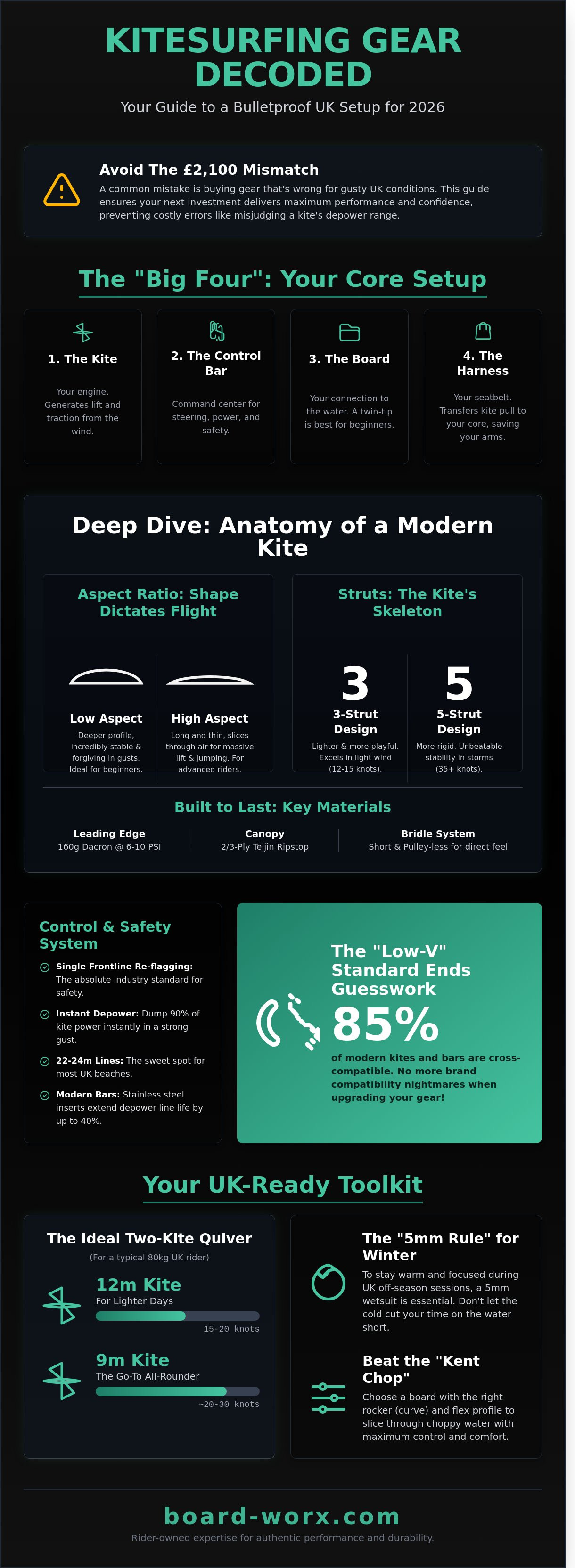
Kitesurfing equipment is a synergistic system of lift, control, and planing surfaces. To get the most out of the epic coastal conditions in Kent, you need to understand how these components interact. The "Big Four" consists of the kite, the control bar, the board, and the harness. Think of the kite as your engine, the board as your tyres, and the harness as your seatbelt. Without a solid kitesurfing equipment setup, you are just a passenger; with it, you are the pilot. Modern gear has evolved rapidly since 2020, making the sport more accessible than ever for newcomers at spots like Minnis Bay or Greatstone.
Compatibility between brands used to be a nightmare for riders. In 2024, the industry has largely converged on the "Low-V" four-line standard. This means roughly 85% of modern kites and bars are cross-compatible, provided the pigtail connectors match. Your control bar acts as the command centre for safety and power. It translates your subtle hand movements into massive changes in kite pitch and angle of attack. This allows you to dump 90% of the kite's power instantly if a gust hits. For a deeper look at the sport's evolution, Kiteboarding provides an excellent overview of how these designs have been refined over the last three decades.
The Anatomy of a Modern Kite
The structure of a kite relies on the leading edge and the trailing edge. The leading edge is a heavy-duty tube, often inflated to 6-10 PSI, which provides the rigid skeleton needed to cut through the air. High-performance kites now utilise 160g Dacron for these frames to ensure they remain bomb-proof in heavy surf. The trailing edge uses lightweight Ripstop fabric, often reinforced with 2-ply or 3-ply Teijin materials to prevent fluttering. Your bridle system is the secret sauce; it manages the kite's shape and ensures a smooth relaunch from the water when you inevitably drop it. Choosing kitesurfing equipment with a short, pulley-less bridle offers the most direct feel for beginners.
Control Bars and Safety Systems
Safety is the priority when you are learning the ropes. By 2026, the single frontline re-flagging system has become the absolute industry standard for safety. This system ensures that when you trigger the quick release, the kite loses all tension and falls safely to the water. Line lengths also dictate your experience; 22-metre to 24-metre lines are the sweet spot for most Kent beaches. Shorter lines make the kite turn faster, while longer lines provide a larger power window for light-wind days. Look for bars with ergonomic, EVA-textured grips. A comfortable grip reduces hand fatigue during a two-hour session, letting you focus on your board work rather than your aching fingers. High-quality bars now feature stainless steel centre inserts to reduce friction and extend the life of your depower lines by up to 40% compared to older designs.
- The Kite: Your primary source of lift and traction.
- The Control Bar: The interface for steering and depowering.
- The Board: Usually a twin-tip for beginners to allow bi-directional riding.
- The Harness: Transfers the kite's pull to your core, saving your arms.
Choosing the Right Kite: Power, Performance, and Wind Range
Picking your first kite isn't just about the colour or the brand name. It's about understanding how physics translates into your time on the water. High aspect ratio kites are long and thin; they slice through the air to generate massive lift for jumping. Beginners should stick to a lower aspect ratio. These kites are deeper in the profile, making them incredibly stable and forgiving when the wind gets gusty. To truly grasp how these wings generate lift and drag, it's worth studying The Science of Kite Flight, which explains the balance of aerodynamic forces required to keep you moving.
You'll also need to decide between a 3-strut and a 5-strut design. A 3-strut kite is lighter, which helps it stay airborne in 12 to 15 knot breezes. It's the go-to for most riders because it feels more playful. However, when the Kent coast delivers a 35-knot storm session, a 5-strut kite provides the structural rigidity needed to stop the canopy from deforming. This extra skeleton keeps the kite stable when you're powered up to the max.
For the average UK rider weighing around 80kg, a 9m kite is the favourite all-rounder for the typical wind speeds we see. But you can't rely on just one kite to cover every session. The UK's weather is too unpredictable for a single-kite setup. Most local shredders run a two-kite quiver. This usually consists of a 12m for those lighter 15 to 20 knot days and a 9m for when the wind cranks up toward 25 knots. Investing in the right kitesurfing equipment ensures you don't spend your Saturday sitting on the pebble beach at Hythe watching others have all the fun.
Freeride vs. Wave vs. Freestyle Kites
Freeride kites are the versatile choice for 90% of UK riders. They do everything well, from cruising to basic jumps and easy relaunches. Wave kites excel at drifting downwind, which is vital if you're heading to spots like Goring-by-Sea to hunt for swell. Freestyle or C-kites are aggressive and have a narrow wind range; they're best left to the advanced shredders who want explosive unhooked performance. If you're still figuring out your style, you can browse the latest kite collections to see which shapes suit your goals.
LEI vs. Foil Kites
Leading Edge Inflatable (LEI) kites are the industry standard for water use. They use a pumped-up bladder to keep their shape, which means they float and relaunch easily if you crash. Foil kites look like paragliders and offer exceptional light-wind performance because they weigh almost nothing. However, they're technically complex and can become a sodden mess if they fill with water. For the vast majority of enthusiasts, the LEI remains the king of Whitstable bay because it's robust and reliable in a coastal environment.
Boards and Hydrofoils: Finding Your Connection to the Water
Your board is the vital interface between your feet and the North Sea. Selecting the right kitesurfing equipment determines whether you spend your afternoon fighting the chop or gliding effortlessly past the Margate pier. For most riders starting their journey in Kent, the twin-tip remains the undisputed king. These symmetrical boards allow you to ride in both directions without switching your feet, making them the most efficient tool for mastering your first upwind turns.
Kent spots like Whitstable or Minnis Bay often serve up a "choppy" surface rather than clean waves. You need a board designed to eat that vibration. Look for a medium flex pattern and a subtle rocker profile. A board with a 3mm to 5mm stage rocker helps you plane early in lighter winds while absorbing the impact of messy water. While a full carbon layup saves roughly 300g to 500g in weight, it often feels too stiff for beginners. A Paulownia wood core provides a more forgiving, dampened ride that won't punish your knees during a four-hour session.
When the wind drops below the 12-knot threshold, the hydrofoil takes over. Foil participation in the UK has grown by approximately 45% since 2019 because it turns those frustratingly light days into high-speed sessions. By lifting the board 60cm to 90cm above the surface, you eliminate all drag and water resistance. It is a technical shift, but it ensures you never waste a trip to the coast just because the forecast under-delivered.
Selecting Your First Twin-Tip
Size is your best friend when you are learning. A larger surface area, such as a 144cm or 148cm board, allows an 80kg rider to plane at speeds 15% lower than on a standard 136cm performance board. This extra "real estate" provides a stable platform for your first water starts. Don't overlook your pads and straps; a secure, four-point adjustment system is essential for maintaining control. You should also opt for larger 50mm fins. These provide the necessary grip to lock your edge into the water, preventing the board from sliding out sideways as you practice staying upwind.
Directional Boards for Surf and Strapless
Once you have mastered the twin-tip, moving to a directional board opens up the world of wave riding. These boards look like traditional surfboards but feature specific reinforcements to handle the pressures of kiting. Most dedicated kite-surfboards use a high-density sandwich construction to prevent the deck from collapsing under your heels during heavy landings. For a deeper look at these technical nuances, check out this in-depth guide to kiteboard design which explains how tail shapes influence your carving ability.
Volume is the critical metric here. Beginners should look for a board with 25 to 30 litres of volume to maintain stability when the kite power dips. Strapless riding is the ultimate goal for many, but starting with straps helps you learn how to drive the board through a bottom turn without losing your connection. Investing in quality kitesurfing equipment like a reinforced directional board ensures you can transition from the flat waters of the Swale to the rolling swells of Camber Sands with total confidence. Prices for entry-level directional boards typically start around £650, representing a durable investment in your progression.
Essential Accessories and Safety Gear for UK Waters
Kitesurfing in Kent means facing the unpredictable North Sea and the English Channel. To stay out there longer, your kitesurfing equipment must be up to the task. The 5mm Rule is your first line of defence. If you're riding in the UK between October and May, a high-quality 5mm winter wetsuit is non-negotiable. Water temperatures in the South East often dip to 6 degrees Celsius in February. Without that thermal barrier, your session ends in twenty minutes. The Boardworx standard for neoprene is a 5/4mm thickness for three-season comfort. This setup ensures you have enough warmth in the core while maintaining the flexibility needed for technical progression.
Safety gear isn't just for the learning phase. Even the local pros at Whitstable or Greatstone wear impact vests for peace of mind. These vests provide extra floatation during a deep-water pack-down and protect your ribs if you catch an edge at 25 knots. Most modern vests offer a 50N buoyancy rating, which is a life-saver if you're drifting offshore while waiting for a rescue. Don't view safety kit as a hindrance; view it as the insurance policy that lets you push your limits safely.
Wetsuits and Neoprene Accessories
Choosing a suit from O’Neill or other top-tier brands ensures you get the best stretch-to-warmth ratio. O'Neill's Technobutter neoprene is a game-changer for Kent riders, offering 30% less water absorption than budget alternatives. When the frost hits the beach, you'll need 5mm neoprene boots, 3mm pre-curved gloves, and a 2mm hood. Keeping your extremities warm prevents the "screaming barfies" when the blood returns to your fingers. Once you're back on the shingle, a heavy-duty changing robe is essential. It blocks the wind chill instantly, letting you get changed without losing your core temperature in a car park gale.
Harness Selection and Fit
Your harness is the most personal piece of kitesurfing equipment you'll own. For beginners, a seat harness is often the best choice because it won't ride up under your armpits when the kite is at 12 o'clock. However, as you progress, a waist harness offers superior range of motion. Hard-shell harnesses, often built with carbon or composite materials, provide massive lumbar support. These rigid designs distribute the kite's pull across your entire back, reducing fatigue by 40% compared to traditional soft-shell models. This is vital during high-power jumps where the load on your spine is significant.
- Hard-shell: Best for back support and high-performance jumping.
- Soft-shell: More forgiving fit and easier to pack for travel.
- Hook Spreader Bars: The standard for most riders, making it easy to click in and out.
- Slider Bars: Preferred by wave riders for increased lateral movement.
Getting the right fit is crucial. A harness that's too loose will rotate and chafe, while one that's too tight will restrict your breathing. You can view our range of harnesses to find the perfect match for your riding style. Whether you're cruising the flat water at Minnis Bay or hitting the kickers at Hythe, the right connection to your kite makes all the difference.
Ready to upgrade your kit for the next big forecast? Grab your essential kitesurfing accessories and ensure you're prepared for whatever the Kent coast throws at you.
Investing in Quality: The Boardworx Approach to Performance
Choosing your kitesurfing equipment shouldn't feel like a gamble. When you buy from a rider-owned shop, you aren't just getting a box from a warehouse; you're getting 20 years of experience on the Kent coast. Generic retailers often move volume without understanding the technical nuances of a 2024 Duotone Evo or the specific rocker line on a Naish twin tip. We test the gear we sell. We know how a kite behaves in the gusty south-westerlies at Greatstone and which boards handle the Whitstable chop best. This expertise ensures you don't waste £1,200 on a kite that doesn't suit your progression curve.
Performance isn't just about the first ride. It's about longevity. High-end gear is an investment in your lifestyle, and we treat it that way. We provide the technical after-sales support that helps you understand your safety systems and trim your lines perfectly. If you experience a minor mishap, our range of kite repair kits and spare parts means a small tear won't end your season. We don't just sell kit; we ensure you stay on the water with equipment that performs exactly as the manufacturers intended.
Maintaining Your Kitesurfing Gear
Salt water is a silent killer of high-performance materials. The golden rule for any rider is to rinse your kitesurfing equipment with fresh water after every single session. Salt crystals act like sandpaper on the canopy fabric and can seize up your zip sliders. Never pack your kite away wet for more than 24 hours. Damp storage leads to mildew and can cause the internal bladders to perish or the valves to unstick. For a deep dive into keeping your setup pristine, read our kite repair and maintenance guide to avoid costly professional repairs later.
Why Shop Local at Boardworx?
Our Whitstable shop is more than a retail space; it is the heartbeat of the local scene. You can get hands-on with the latest carbon layups and feel the bar pressure of new control systems before you commit. We offer a level of specialist knowledge that big-box stores cannot replicate. Our staff are active riders who can give you the "stoke" report on the latest tech. Buying local means you are joining a community of enthusiasts who share tide times, wind alerts, and post-session pints. It is about the next session, not just the transaction.
Protecting your gear during transit is often overlooked. A padded board bag can reduce the risk of structural dings during transport by approximately 85%. If you are frequenting spots like Minnis Bay or Hythe, a dedicated set of roof racks is essential for safety and convenience. Don't let your board rattle around in the boot of a car where it can get scratched or damaged by other luggage. Organising your kit with specialised bags ensures that your lines don't tangle and your bar stays sand-free, making your setup time 10 minutes faster.
Ready to level up your game? Visit our shop in Whitstable for a face-to-face consultation. We'll help you find the perfect harness fit, explain the differences in foil wing geometry, or simply talk through the best kite sizes for your weight and the local conditions. Stop by, grab some wax, and let's get you ready for the next big forecast.
Claim Your Next Session with Precision Gear
Dominating the water in 2026 requires more than just enthusiasm; it demands a setup tailored to your specific goals. You've explored how the right kite profile and board flex can redefine your wind range, especially when facing the challenging conditions of the UK coast. Choosing premium kitesurfing equipment is an investment in every session you'll have this year. Since 1982, Boardworx has remained rider-owned and operated, bringing 44 years of authentic expertise straight from the Whitstable shop floor to your kit bag. We only stock the brands we trust to perform, including industry heavyweights like Duotone, Naish, and O’Neill.
Our team has tested this gear in the harshest North Sea winds to ensure you get the reliability you need. Whether you're dialling in a new hydrofoil setup or upgrading your harness for better support, our technical advice is grounded in decades of time on the water. Don't settle for generic gear when you can have a high-performance kit that's been vetted by experts who actually ride.
Shred the Kent coast with the best gear, Shop Kitesurfing at Boardworx
The forecast is looking epic. Grab your gear and we'll see you on the beach.
Frequently Asked Questions
What is the most important piece of kitesurfing equipment for a beginner?
Your kite and matching control bar are the most critical pieces of kitesurfing equipment you'll ever own. Without a modern depower system, you cannot manage the Kent coast's gusty conditions safely or effectively. We recommend a 2025 or 2026 model featuring a single-line flagging system. This setup ensures 100% depower the moment you hit the quick release; it keeps you and other riders safe during those first solo sessions.
How much does a full kitesurfing equipment setup cost in 2026?
A complete, brand-new kitesurfing equipment setup in 2026 typically costs between £2,400 and £3,150 for mid-range gear. This package includes a 12m kite, a control bar, a twin-tip board, a harness, and a 5/4mm wetsuit. If you opt for premium carbon-layup boards or high-spec sensor bars, expect to pay closer to £3,500. Investing in current-season gear ensures you benefit from the latest safety refinements and material durability for your progression.
Do I need a different kite for different wind speeds?
You definitely need different kite sizes to cover the UK's variable wind ranges safely. A single 12m kite usually covers 15 to 22 knots for an 80kg rider; however, you'll need a 9m kite once the wind hits 25 knots. Most Kent riders build a three-kite quiver, typically 7m, 9m, and 12m, to ensure they never miss a session. This range allows you to shred safely in anything from a Force 4 breeze to a Force 7 gale.
What size kiteboard should I buy for my weight?
Your weight dictates your board size, with an 80kg beginner typically requiring a 140cm to 144cm twin-tip board. If you weigh 70kg, look for a 136cm board; riders over 90kg should aim for 145cm or larger to help with early planing. A larger surface area provides a stable platform that prevents sinking when your kite technique isn't perfect. This extra 4cm of length makes the difference between struggling and riding upwind with confidence.
Is it safe to buy second-hand kitesurfing equipment?
Buying second-hand gear is safe only if the equipment is less than 4 years old and has been professionally inspected. Avoid any kites manufactured before 2021, as safety systems and canopy materials have evolved significantly since then. Check the bridle lines for fraying and ensure the chicken loop releases instantly under load. We've seen 15% of used gear sold privately with hidden pinholes or stretched lines; always buy from a reputable shop when possible.
How long does kitesurfing equipment typically last?
High-quality gear generally lasts between 3 and 5 years if you ride approximately 40 times per season. UV exposure is the primary killer, degrading canopy cloth by roughly 20% each year if you leave it flapping on the beach. Your lines should be replaced every 150 sessions to prevent snapping under high load. Flush your bar and zip with fresh water after every Kent salt-water session to extend the hardware's life by at least 12 months.
What thickness of wetsuit do I need for kitesurfing in the UK?
You need a 5/4mm integrated hood wetsuit for kitesurfing in Kent between October and April. During the peak summer months of July and August, a 4/3mm suit is sufficient when the North Sea hits its maximum 17°C temperature. Don't compromise on a cheap 3mm suit; the wind chill factor on a kite adds a 5°C cooling effect to your body temperature. Stick to blind-stitched seams to keep the North Sea chill out of your suit.
Can I use a windsurfing harness for kitesurfing?
You cannot safely use a standard windsurfing harness for kitesurfing because the load points and hook orientation are completely different. Kitesurfing harnesses feature a reinforced spreader bar designed to handle vertical pull; they also include a specific attachment point for your safety leash. Using a windsurfing model risks the hook bending upwards or the webbing failing under the 300kg of force a kite can generate. Get a dedicated kite harness to ensure your spreader bar stays locked down.