

Wing Foils: The Ultimate 2026 Guide to Performance and Gear
Why are 65% of UK riders still struggling to stay in the air during a typical gusty Solent session? It isn't a lack of skill; it's usually a technical mismatch between their wing foils and the messy coastal chop. We've all felt that hesitation on the shop floor, terrified of dropping £2,000 on a high-performance setup only to realise it's too twitchy for our local break. You want gear that fuels your progression rather than something that ends up on a second-hand forum after three months of frustration.
This guide will strip away the marketing fluff to help you build a 'forever' setup. We'll break down the carbon versus aluminium price gap and explain exactly how to match your foil to your board for maximum stability in varied UK wind conditions. From the mechanics of high-aspect lift to the latest 2026 mast geometries, we're diving deep into the tech that will keep you shredding through every winter gale with total confidence.
Key Takeaways
- Master the fundamental physics of hydrofoil lift to nail your first take-offs and experience the pure stoke of gliding above the chop.
- Learn why mast height and front wing surface area are critical for handling the unique, gusty conditions found across UK coastlines.
- Discover how to choose the right wing foils for your progression, ensuring your setup matches your board's track system and your budget.
- Optimise your lift-to-drag ratio to keep you flying through lulls, turning frustrating sessions into epic high-performance runs.
- Leverage 40 years of rider-owned expertise from our Whitstable hub to invest in gear that is tried, tested, and built to shred.
What are Wing Foils and why have they revolutionised watersports?
Wing foiling isn't just a passing trend; it's a total shift in how we interact with the ocean. At its core, the sport relies on wing foils to lift the rider completely out of the water, eliminating the drag that holds back traditional windsurfers and sailors. This hydrofoil technology works on the same principles as an aircraft wing. As water flows over the curved surface of the foil, it creates a pressure differential. This generates upward lift. By 2026, foil profiles have become so efficient that they can generate stable flight at speeds as low as 5 knots. This means you aren't waiting for a gale to have an epic session. If there's enough breeze to fly a kite, you can likely be up on the foil.
The "stoke" factor here is off the charts compared to traditional disciplines. Windsurfing often requires heavy gear and 15 knots of wind just to plane. Kitesurfing offers incredible jumps but comes with 25-metre lines that make launching in tight UK coastal spots a challenge. Winging sits in the sweet spot. It's silent, it's free, and it's incredibly portable. To understand the full scope of this evolution, it helps to look at What is Wing Foiling? and how it has branched away from its windsurfing roots. In 2026, we've seen a 20% increase in "session days" for the average rider because the gear now works in such a wide range of conditions.
Why is 2026 the definitive year to get involved? The industry has reached a pinnacle of material science. We've moved past the heavy, cumbersome setups of the early 2020s. Modern wing foils now utilise Ultra-High Modulus (UHM) carbon fibre and titanium hardware as standard, resulting in kits that are 18% lighter than 2024 models. This weight reduction makes the foil more responsive to your input and much easier to carry down the beach. Accessibility has also skyrocketed. The latest designs are inherently stable, meaning riders aged 12 to 75 are now successfully foiling within three or four lessons. It’s a low-impact sport that rewards finesse over brute strength.
The Anatomy of a Modern Hydrofoil
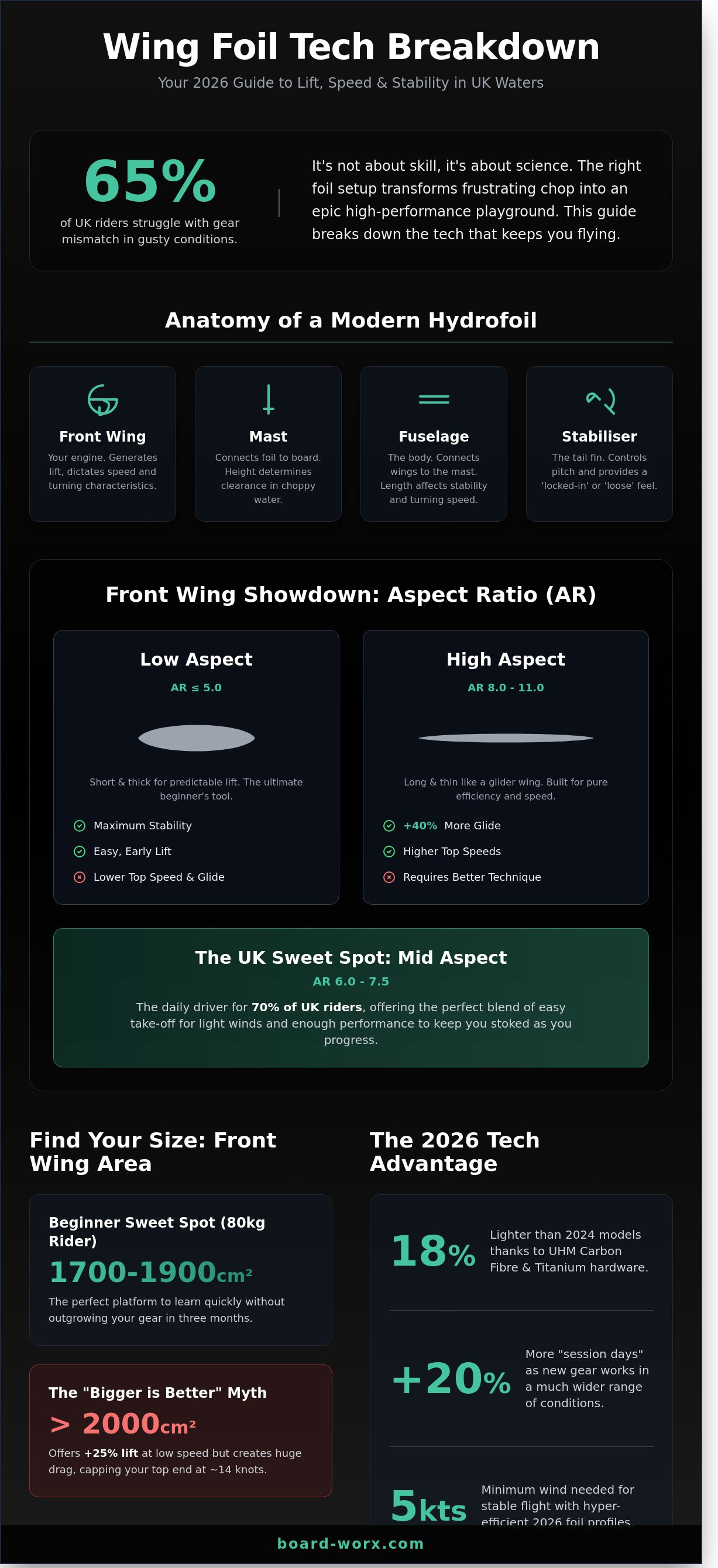
The front wing is your engine. It dictates your lift, top speed, and stability. In 2026, high-aspect wings are the go-to for glid, while mid-aspect wings offer the easiest entry for beginners. The stabiliser, or rear wing, acts as your tail fin. It controls your pitch, preventing the board from bucking like a bronco. A larger stabiliser provides a "locked-in" feel, whereas a smaller one increases "pumpability" for connecting swells. Connecting these is the fuselage. A shorter fuselage allows for tight, aggressive turns; a longer one provides the tracking stability needed for high-speed cruising across the bay.
Wing Foiling vs. Wing Surfing: Clearing the confusion
Terminology matters when you're buying gear. Wing surfing is the act of using a handheld wing while staying on the water's surface, typically on a large paddleboard. It’s the "slogging" phase. The moment you add a hydrofoil and rise above the surface, you're wing foiling. This transition from displacement to flight is the most addictive feeling in watersports. Your choice of foil determines how fast you make this jump. A foil with a generous surface area, perhaps around 1800cm², will get you flying sooner and keep you there, significantly shortening the learning curve for new riders.
The Technical Breakdown: Front Wings, Masts, and Aspect Ratios
Your setup is a game of trade-offs. Choosing the right wing foils involves balancing lift, speed, and stability to match your local conditions. Surface area is your first big decision. Beginners often gravitate toward massive wings over 2000cm², thinking more carbon equals more safety. While a 2400cm² wing offers 25% more lift at low speeds, it creates significant drag that caps your top speed at roughly 14 knots. For an 80kg rider, a 1700cm² to 1900cm² front wing provides the perfect platform to learn without outgrowing the gear in three months. If you are just starting, check out this beginner's guide to wing foiling to understand how these components interact during your first flight.
Low Aspect vs. High Aspect Wings
Aspect Ratio (AR) is the ratio of a wing's span to its chord. Low aspect wings (AR 5.0 or less) are short and thick. They provide predictable lift and don't stall easily, making them the ultimate tool for your first sessions. High aspect wings (AR 8.0 to 11.0) are long, thin, and look like glider wings. These are built for pure efficiency. You get 40% more glide and higher top speeds, but they require better technique to get on foil. Mid aspect wings (AR 6.0 to 7.5) are the daily drivers for 70% of UK riders. They offer enough "get up and go" for light winds while remaining agile enough to shred waves at Camber Sands or Hayling Island.
Mast Length: Dealing with the UK's coastal chop
Your mast is your height above the water. While a 65cm mast is great for shallow estuaries or gaining confidence, it's often too short for the open sea. UK coastal waters are notorious for messy, short-period chop. An 82cm or 85cm mast gives you the necessary clearance to fly over 40cm peaks without the board hitting the water. This extra length also allows you to lean harder into turns without the wing tips breaching the surface.
- 65cm Masts: Best for learning in flat, shallow water or sandbar-protected lagoons.
- 75cm Masts: The "all-rounder" for inland lakes and calmer coastal days.
- 85cm+ Masts: Essential for high-performance carving and navigating the North Sea swell.
Material choice impacts your wallet and your ride. Aluminium masts are cost-effective, typically starting around £100, but they are heavier and can flex under high loads. Carbon masts are 30% lighter and significantly stiffer, providing a direct connection to the foil. This stiffness ensures that when you move your feet, the foil reacts instantly. If you want to feel every nuance of the water, it's worth the jump to a high-modulus carbon setup.
Don't overlook the fuselage and its effect on "swing weight." A shorter fuselage makes the foil feel twitchy and ultra-responsive, which is perfect for tight carves. A longer fuselage increases longitudinal stability, making it easier to maintain a steady flight height. Moving your foil tracks just 2cm forward in the board boxes can completely change the lift characteristics, giving you more front-foot pressure for early take-offs. If you're ready to upgrade your flight feel, you can explore our latest foil components to find your perfect match.
Choosing Wing Foils for UK Conditions: Stability vs. Speed
Let's be honest; the UK coast isn't exactly a mirror-flat lagoon in the Maldives. Most of our sessions involve tackling messy two-foot chop and gusty south-westerlies that change intensity every five minutes. When you're picking wing foils for home waters, you need gear that handles the reality of the British sea state. Stability isn't just a beginner requirement here; it's what keeps you flying when the North Sea gets moody.
The lift-to-drag ratio is your most important metric. In the UK, wind is rarely a steady breeze. You'll often deal with 25-knot gusts followed by 12-knot lulls. A foil designed with a focus on high lift ensures you stay on the plane during those inevitable soft spots. High-speed racing foils look sleek, but they're useless if you drop off the foil every time the wind dips. We advocate for gear that prioritises low-end performance. You want a wing that generates lift at speeds as low as 8 mph. This allows you to get foiling early and stay up longer, maximising your time on the water.
The Global Wingsports Association (GWA) provides a fantastic framework for understanding foil disciplines, but for your daily session at a local beach, durability is the real priority. Our salt water is incredibly corrosive. By 2026, manufacturers have significantly improved anodization processes, yet galvanic corrosion remains a constant threat. If you're mixing aluminium masts with carbon wings, you must apply Tef-Gel to every single bolt. One missed service after a salty session at a spot like Hayling Island could seize your gear permanently. It's about protecting your investment so it's ready for the next epic forecast.
Foiling in the South East: A Whitstable Case Study
Whitstable is a prime example of why local knowledge beats a generic spec sheet every time. You're dealing with a massive 6-metre tidal range and notorious shallow banks across the Thames Estuary. For riders in these parts, we recommend mid-sized front wings between 1500cm2 and 1800cm2. This surface area provides the grunt needed to clear the messy shore dump and navigate turbulent currents. A larger stabiliser is equally vital. It acts like a rudder in the wash, providing the pitch control necessary to keep your ride level when the tide starts to rip at 4 knots.
Material Science: Carbon Fibre vs. Aluminium
Weight is the enemy of performance. A full carbon setup is typically 1.5kg lighter than its aluminium counterpart. This difference is massive when you're trying to link bumps or improve your pump efficiency. The standout trend for 2026 is the widespread use of high-modulus (HM) carbon. This material is roughly 30% stiffer than standard carbon layups. Increased stiffness means there's zero lag between your foot input and the foil's reaction. It makes for a precise, connected feel that's essential for carving. While aluminium is still the king of value for those starting out, upgrading to an HM carbon mast is the single best way to sharpen your wing foils setup for high-performance shredding.
- Aluminium: Affordable, robust, but requires frequent rinsing and Tef-Gel application.
- Carbon Fibre: Lightweight and stiff; the best choice for advanced pumping and jumping.
- High-Modulus Carbon: The 2026 gold standard for elite stiffness and direct control.
The Wing Foil Buying Guide: From First Flight to Pro Carver
Choosing your first setup is a massive milestone. In 2026, the market for wing foils has matured, offering gear that's more specialised than ever. You need a clear plan before you drop your hard-earned cash. A basic entry-level aluminium setup typically starts around £1,200. If you're eyeing up pro-tier, high-modulus carbon rigs, expect to invest upwards of £3,800. This price gap reflects the massive jump in weight reduction and stiffness that define elite performance.
Compatibility is your first technical hurdle. Most modern boards utilise the 90mm US Box track system. Always verify that your mast plate matches this standard before buying. If you mix brands, you might find yourself needing a base plate adapter, which adds unnecessary weight. Stick to a modular system from the start. Brands like F-One, Armstrong, and Sabfoil allow you to swap front wings and stabilisers while keeping the same mast and fuselage. This modularity saves you roughly 40% on upgrade costs as your skills evolve.
Don't be tempted by ancient used gear. A foil from 2022 might look like a bargain at £400, but 2026 technology has rendered those older profiles obsolete. Modern wing foils offer 35% less drag and significantly better low-end lift. Buying a "dinosaur" will only frustrate your progress and leave you stuck on the water while everyone else is flying.
The Beginner's Setup (0-12 Months)
Focus on stability and early lift. You want a front wing with at least 1800cm2 of surface area. This ensures you're up on the foil in light winds, typically around 10 knots. Opt for an aluminium mast for your first season. It's durable, cost-effective, and can handle the inevitable knocks against the seabed. Safety is non-negotiable. An ISO-rated buoyancy aid and a dedicated hard-shell helmet are essential. Impact vests can reduce the sting of high-speed spills by 50%, keeping you confident and in the game.
The Intermediate Upgrade (1-3 Years)
Once you're carving consistently, it's time to shed the drag. Step down to a front wing between 1000cm2 and 1250cm2. This smaller surface area unlocks higher speeds and tighter turns. Switch to a carbon mast to experience that "pingy" tactile response. Carbon doesn't just save weight; it transfers your foot pressure to the wing instantly. You should also start experimenting with different stabilisers. Swapping to a smaller tail wing or adjusting the shim angle can completely transform how the foil pitches, giving you a custom-tuned ride for specific wave conditions.
Ready to find the perfect rig for your next session? Check out our expert-tested range of high-performance wing foils at Board-Worx and get on the water today.
Why Boardworx is the UK's Premier Wing Foil Hub
Since 1984, Boardworx has stood as a cornerstone of the UK watersports community. We’ve spent over 40 years based in Whitstable, Kent, evolving alongside every major shift in wind and water tech. We aren't just a warehouse shifting boxes; we're a rider-owned shop where every member of the team spends their downtime chasing gusty winds and perfect swells. When you buy from us, you're getting gear that has been rigged, ridden, and pushed to its limits by people who know exactly how it feels to stick a landing or pump through a lull. This deep-rooted expertise ensures that every recommendation we make is backed by decades of salt-water experience and a genuine passion for the sport.
Our 2026 inventory represents the absolute peak of current design. We stock the latest wing foils from industry heavyweights like Naish, F-One, and Fanatic. These aren't just catalog entries. They are precision tools we've selected because they deliver genuine performance gains on the water. Whether you’re looking for the lightning-fast response of a high-aspect carbon wing or the rock-solid stability of an entry-level aluminium set-up, our stock reflects the best of the 2026 season. We offer national UK shipping and a level of expert support that's just a phone call away. If you’re stuck between two front wing sizes or can't decide on the right mast length for your local break, we’ll give you the technical breakdown based on real-world testing.
- Rider-Tested Gear: We only sell the equipment we actually use. If a foil doesn't meet our standards for torsional stiffness or lift, it doesn't make it onto our shelves.
- 2026 Brand Leaders: Our collection includes the newest releases from Naish, F-One, and Fanatic, featuring cutting-edge carbon layups and refined fuselage geometries.
- Technical Authority: Our team understands the nuances of chord thickness, aspect ratios, and tail wing shims, helping you tune your ride for maximum efficiency.
- National Reach: While our heart is in Kent, our reach is nationwide. We provide fast, secure delivery to every corner of the UK, backed by professional packaging.
Visit Our Whitstable Store
You can find us at our Beach Walk location, just a stone's throw from the water. There is no substitute for getting your hands on the gear before you buy. You can feel the weight of a high-modulus carbon mast or check the profile of a 2026 wing in person. Our crew provides expert advice on local Kent spots like Tankerton or Minnis Bay, ensuring your gear matches the specific coastal conditions you'll face. We build custom wing foils packages tailored to your weight and skill level, ensuring your first flight is as smooth as possible. We’ll help you dial in your setup so you can spend less time faffing with bolts and more time on the foil.
Shop Online with Confidence
If you can't make it to the Kent coast, our online store brings the Boardworx experience to your screen. We provide detailed technical specs, including exact fuselage lengths and wing surface areas, paired with high-res imagery for every product. Every order is handled with care and shipped fast across the UK. We know you want to get on the water, so we don't hang around with dispatch. Use our site to compare the latest tech and secure your setup for the next big forecast. Explore our full range of 2026 Wing Foils here and get ready to elevate your session.
Claim Your Flight and Master the Water
The 2026 season marks a massive leap in hardware efficiency. You've now got the technical breakdown of how high aspect ratios and stiff carbon layups translate into pure speed and tighter carves. Choosing the right wing foils for UK conditions means finding that sweet spot between low-end lift for light winds and the control needed for 25-knot gusts. Since 1982, Boardworx has operated as a rider-owned hub where technical expertise meets genuine passion for the sport. We don't just shift boxes; we've spent over 40 years testing gear to ensure you get the perfect setup for your local break. When you're ready to upgrade, we provide free UK shipping on major foil orders alongside a massive inventory of technical wetsuits and safety gear. Every piece of equipment in our shop is selected to help you shred harder and stay out longer. Stop overthinking the specs and start planning your next epic session. The water is waiting for you.
Shop the latest 2026 Wing Foils at Boardworx
Frequently Asked Questions
What size front wing should a beginner start with for wing foiling?
Beginners should start with a front wing size between 1800cm² and 2200cm² to ensure maximum stability and early lift. This surface area allows you to get onto the foil at speeds as low as 8 knots, which is essential for learning wing control without needing excessive power. Larger wing foils provide a stable platform that forgives poor foot placement, making your first 5 sessions much more productive and less exhausting.
Is carbon fibre worth the extra cost for a first wing foil?
Aluminium is generally the better choice for your first setup because it is more durable and saves you between £400 and £700 on the initial purchase. Beginners frequently clip the seabed or drop gear on the slipway; aluminium masts handle these impacts far better than brittle carbon. You can upgrade to carbon once you are consistently gybing and want that 15% increase in stiffness and weight reduction for high-performance shredding.
How long does it take to learn to wing foil in UK waters?
Most riders require 15 to 20 hours of active water time to achieve sustained flights in typical UK coastal conditions. If you have previous experience in windsurfing or kiting, you might cut this down to 10 hours. Expect to spend at least 3 sessions mastering wing handling on a large board before you start foiling. Consistent 15-knot winds at spots like Camber Sands provide the best environment for rapid progression.
Can I use the same foil for winging, SUP foiling, and surf foiling?
You can use the same modular foil system across different disciplines by simply swapping the front wing or fuselage to suit the activity. A 1500cm² mid-aspect wing is a fantastic "one-wing quiver" that works for winging in 20 knots or catching rolling swell on a SUP. Investing in a versatile brand like Sabfoil or F-One means you only need one mast and plane set to cover every foil sport you enjoy.
What mast length is best for the choppy conditions in Kent?
An 82cm mast is the ideal length for navigating the short, erratic chop found at Kent beaches like Whitstable or Hythe. A shorter 60cm mast will cause the wing to "breach" and lose lift as you drop into wave troughs. The 82cm length provides approximately 20cm of clearance to fly over the mess while remaining short enough to avoid hitting the bottom in the shallow tidal waters of the Thames Estuary.
How do I maintain my wing foil to prevent salt water damage?
Rinse your foil with fresh water after every session and completely disassemble the components every 14 days to apply Tef-Gel to the bolts. Salt water triggers galvanic corrosion between stainless steel bolts and aluminium parts, which can weld them together in under 3 weeks. Spending 10 minutes on this fortnightly maintenance routine protects your £1,200 investment and ensures you can always change your wing foils to suit the daily conditions.
What is the difference between high aspect and low aspect foils?
High aspect foils are long and narrow for maximum glide and speed, whereas low aspect foils are shorter and wider for stability and low-speed lift. A high aspect wing usually has a ratio above 8.0 and is designed for riders who want to pump between waves or reach speeds over 20 knots. Low aspect wings are the best choice for beginners because they offer a predictable feel and don't stall easily during slow turns.
Do I need a specific board for my wing foil, or will any board work?
You must use a dedicated foil board featuring reinforced twin US tracks to handle the extreme leverage forces generated by the mast. Standard surfboards or SUPs lack the internal structure and will fail in under 10 minutes of use. Modern wing boards are also significantly shorter, typically ranging from 4'8" to 6'0", which reduces swing weight and makes the foil much easier to control during transitions and jumps.